
What Are Velcro Patches?
A Velcro patch is any patch embroidered, PVC, woven, or printed that has a hook-and-loop fastener (commonly called Velcro) on its back, allowing it to attach to and detach from a mating loop panel on a hat, jacket, bag, tactical vest, or any Velcro-equipped surface.
The “Velcro” name is technically a brand name (owned by Velcro IP Holdings), but it’s become the generic term for all hook-and-loop fasteners, much like “Kleenex” for facial tissue. In the patch industry, hook-and-loop patches, loop-back patches, and Velcro-backed patches all mean exactly the same thing.
What makes them exceptional is the combination of strength and total reversibility. A well-made Velcro patch holds firmly under field conditions, wind, movement, and gear stacking, but peels off in a second when you want to swap it. This makes them the preferred backing for:
- Military and law enforcement uniforms requiring unit identification swap-outs
- Tactical and plate carrier setups with interchangeable patch panels
- Airsoft and paintball gear loadouts
- Sports helmets, bags, and team gear
- Hats and caps with built-in front loop fields
- Morale patch collections displayed and rotated on loop panels
At The American Patch, we apply hook-and-loop backing to any of our custom patch types, embroidered, PVC, woven, or sublimated, all produced in the USA with high-grade Velcro material.
How Hook & Loop Actually Works
The genius of hook-and-loop fasteners is mechanical, not chemical. No glue, no heat, just physics. Here’s how it works:
| Side | Texture | Structure | Goes On |
| Hook side | Rough/scratchy | Thousands of tiny, rigid plastic hooks (like microscopic fishhooks) | Back of the patch |
| Loop side | Soft/fuzzy | Thousands of tiny fabric loops (like a dense carpet of soft rings) | Hat, jacket, panel, gear |
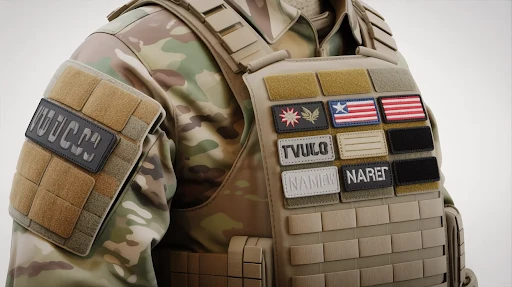
When the two sides are pressed together, the hooks latch into the loops like millions of tiny anchors. Pulling the two surfaces apart (at an angle rather than straight back) disengages the hooks sequentially, releasing cleanly with that characteristic ripping sound.
Why Hook-and-Loop Strength Matters for Patches
Patch-grade hook-and-loop uses high-density nylon hooks and loops, rated for far higher shear strength (resistance to sideways sliding) than peel strength (resistance to peeling apart). This is intentional. Patches need to stay put during physical activity but release easily when pulled at an angle.
Cheap hook-and-loop loses grip after 200–500 cycles. Military-spec and patch-grade hook-and-loop is tested to 10,000+ attachment cycles while maintaining over 90% of original grip strength.
Lint is the #1 enemy of Velcro patches.
Fabric fibers, thread, and lint fill the hook teeth over time, reducing grip. Clean regularly with a stiff brush, tape, or a fine-toothed comb to restore full holding power.
Types of Velcro Patches
Velcro backing can be applied to virtually any patch construction type. Here’s the complete landscape:
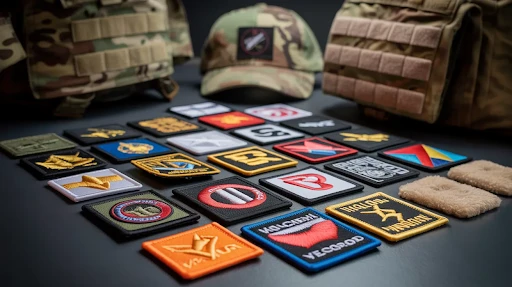
| Patch Type | Construction | Best For | Detail Level | Weight |
| Embroidered Velcro Patches | Stitched thread on twill base with Velcro sewn to back | Military, scouts, uniforms, clubs, brand logos | Medium–High | Light |
| PVC / Rubber Velcro Patches | Molded soft PVC with Velcro heat-sealed or sewn to back | Tactical, military, outdoor, airsoft, law enforcement | High (3D texture) | Medium |
| Woven Velcro Patches | Thread woven directly into the patch structure + Velcro back | Fine text, name tapes, small insignia | Very High | Very Light |
| Sublimated / Printed Velcro Patches | Full-color dye-sublimation print on fabric + Velcro back | Photographic imagery, gradients, unlimited color designs | Unlimited | Light |
| Reflective Velcro Patches | Retroreflective material with Velcro backing | Law enforcement, safety personnel, nighttime visibility | Medium | Light |
| IR (Infrared) Velcro Patches | IR-reactive material, visible only under night-vision; Velcro-backed | Military special operations, tactical night missions | Low (IR flag/unit ID) | Light |
| Glow-in-Dark Velcro Patches | Phosphorescent material + embroidery + Velcro back | Night operations, events, airsoft, novelty | Medium | Light |
| Leather Velcro Patches | Genuine or faux leather panel with Velcro sewn to the back | Biker gear, premium fashion, specialty applications | Medium | Medium–Heavy |
| Chenille Velcro Patches | Raised chenille yarn on felt/wool + Velcro sewn to back | Varsity jackets, collegiate, letterman gear | Low (iconic shapes) | Medium |
Velcro vs Sew On vs Iron On Patches: Which Should You Choose?
The backing method you choose determines versatility, permanence, and use-case suitability. Here’s the definitive comparison:
| Factor | Velcro / Hook & Loop | Sew On | Iron On |
| Removability | Fully Removable | Permanent | Semi-Permanent |
| Swappability | Swap in seconds; reuse indefinitely | Requires cutting stitches to remove | Single-use bond on most fabrics |
| Durability / Hold | Excellent when the panel and patch are well-made | Best, thread outlasts any other method | Good for light use; weakens after 15–25 washes |
| Application time | 1 second (patch-to-panel press) | 10–30 minutes per patch | 1–3 minutes per patch |
| Fabric compatibility | Any fabric that accepts a loop panel | Nearly all fabrics, including leather | Not leather, nylon, or heat-sensitive fabrics |
| Professional / Official use | Military standard (FRACU/OCP uniforms) | Also accepted | Not accepted for military or official uniforms |
| Upfront cost | Slightly higher (Velcro material + panel needed) | Lower patch cost; labor cost for sewing | Lowest |
| Collectibility & display | Perfect, panels display multiple patches | Permanent on one garment only | Permanent |
| Best use cases | Military, tactical hats, airsoft, morale patch collections, and interchangeable gear | Motorcycle vests, scout uniforms, permanent decoration, workwear | Light fashion use, crafts, quick decoration |
Best of all worlds: Many serious patch users do all three, Velcro-backed patches on their daily gear (hats, bags, plate carriers), sewn-on patches for their vests or permanent uniform pieces, and iron-on patches for casual clothing.
Hook Side vs Loop Side — What Goes Where?
This is one of the most searched questions in the entire patch world: “Which side of Velcro goes on the patch?” Here’s the clear, definitive answer:
| Velcro Side | Feel | Goes On | Why |
| Hook side (rough, scratchy) | Stiff, bristly — like a tiny brush | Back of the patch | The hooks grab into the soft loop field on the gear; the hooks face outward from the patch to engage the panel |
| Loop side (soft, fuzzy) | Velvety, plush, like felt | Hat, jacket, vest, bag, panel | The soft loops receive and hold the hook teeth from the patch; loop panels can be touched without scratching fabric or skin |
What If You Have It Backwards?
If you’ve sewn the loop side onto your patch and the hook side onto your hat panel, it still technically works, hook and loop are always used together, regardless of orientation. The practical problem: hook-side panels on gear snag fabric, skin, and other materials constantly, making them uncomfortable and damaging to adjacent textiles. Always put a loop on the wearable surface.
Standard Velcro Patch Sizes Explained
Velcro patches have become standardized around a few key dimensions, driven entirely by US military uniform specifications and hat panel sizes. Knowing these saves you from ordering patches that won’t fit your intended gear.
| Size | Common Name | Fits On | Primary Use |
| 2″ × 2″ | Mini / Small | Small hat panels, chest patches, mini panels | Brand logos, small morale patches, unit coins |
| 2″ × 3″ | Standard Morale Patch | Military sleeve panels, hat fronts, and most tactical gear panels | Morale patches, flag patches, US and foreign flags |
| 3″ × 3″ | Large Square | Shoulder loops, chest panels, range bags | Unit crest, detailed logo, airsoft team insignia |
| 3½” × 2½” | Medium | Helmet bands, accessory pouches | Specialty mil-spec patches, JSOC / SOF insignia |
| 4″ × 2″ | Name Tape Width | Chest name tape panels, ranger hat bands | Name tapes, blood type patches, role ID |
| Custom | Any size | Any surface with a matching loop panel | Brand, event, large back patches, display panels |
Need a size that isn’t listed? The American Patch makes fully custom Velcro patches in any dimension with no minimum order.
Velcro Morale Patches: The Complete Story
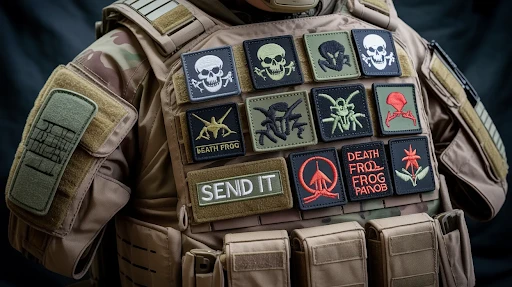
Morale patches are the soul of Velcro patch culture. Born from necessity in the US military, they’ve evolved into a global phenomenon touching every corner of tactical, outdoor, and everyday life.
What Is a Morale Patch?
A morale patch is an unofficial patch, not a regulation unit insignia or rank badge, typically featuring humorous, motivational, pop culture, or unit-specific inside-joke designs. They originated with US special operations forces in the early 2000s, who started wearing unofficial patches on their plate carriers and helmets to build team identity and lighten the psychological load of combat deployments.
The most iconic early morale patches include the infra-red (IR) “Death Frog” (widely attributed to SEAL Team operators), various subdued Jolly Roger designs, and the countless “I’m Fine” or “Send It” style patches that became standard kit on any operator’s gear.
Why Velcro is Essential for Morale Patches
The interchangeable nature of Velcro is what makes morale patch culture work. Collectors amass dozens or hundreds of patches, rotating what they display on their hats, bags, and vests. Without Velcro, every patch would require permanent commitment, but with hook-and-loop, your loadout can be different every day.
Popular Morale Patch Themes
- Funny/humorous — Irreverent humor, memes, military in-jokes
- Motivational — “Never Quit,” “Send It,” “Let’s Get It” designs
- American flag — Full color, subdued, reverse flag, distressed flag patches
- Skulls — Subdued and full-color skull morale patches across all branches
- Unit or team specific — Custom patches for specific units, ranges, or teams
- Brand/sponsor — Gun brands, knife makers, optics companies
- Fantasy/pop culture — Star Wars, gaming references, retro logos
- Political/patriotic — Don’t Tread on Me, Thin Blue Line, various flag designs
- Cool animals — Bears, wolves, eagles, frogs (a nod to SEAL culture)
Pro tip for collectors: Store your morale patch collection on a loop panel display board, a frame mounted with loop-side material that lets you display and rotate your collection like a gallery. These are available in various sizes and make great wall displays for any office, range room, or gear room.
Military & Tactical Velcro Patches
The US military is the birthplace of Velcro patch culture, and today, hook-and-loop patch panels are built directly into every branch’s current combat uniform. Here’s what you need to know:
Velcro Patch Fields on US Military Uniforms
| Branch | Uniform | Standard Patch Panels | Standard Patch Size |
| Army | OCP (Army Combat Uniform) | Left sleeve, right sleeve, chest (name tape), flag | 2″ × 3″ (sleeve), 4″×2″ (name tape) |
| Marines | MCCUU | Left sleeve (unit), right sleeve (US flag), name tape | 2″ × 3″ standard |
| Navy | NWU Type I / III | Left chest, left sleeve | 2″ × 3″ standard |
| Air Force | OCP | Left sleeve, right sleeve, name tape, command insignia | 2″ × 3″ and 3″ × 3″ |
| Special Forces | Various / Non-standard | Plate carrier, helmet, chest rig, multiple panel positions | Multiple sizes; custom common |
Military Velcro Patch Regulations
Army patches and Official unit patches, rank, and identification patches on military uniforms must conform to branch-specific regulations (Army AR 670-1, Marine Corps MCO P1020.34, etc.). Morale patches are generally not authorized on formal uniform pieces but are widely worn on non-regulation gear (range bags, plate carriers in permissive environments, off-duty gear, and helmets in some commands).
Law Enforcement & First Responder Velcro Patches
Police, fire department, EMS, and other first responder agencies increasingly use Velcro-backed patches for:
- Jurisdiction/agency identification patches on tactical vests and plate carriers
- Role identification patches,”POLICE,” “FIRE,” “EMS,” “PARAMEDIC,” “K-9”
- SWAT / tactical team patches on plate carriers
- Reflective patches for nighttime visibility
- Custom K-9 unit patches, often in PVC for weatherproof durability
Velcro Patches by Use Case — Who Uses Them & How
Military & Veterans
Unit insignia, blood type, IR flags, and rank patches on ACUs, OCPs, plate carriers, and helmets. Veterans display collections on range bags and tactical gear as a point of pride.
Law Enforcement
Agency ID, role designation, SWAT/ESU patches, and reflective identification on vests and tactical carriers. Interchangeability is critical for multi-role officers.
EMS & Fire
First responder patches on turnout gear and tactical medic vests. Blood type, unit, and specialty patches (Paramedic, EMT-B, TEMS) in Velcro for quick role identification.
Airsoft & Paintball
Team patches, faction insignia, hit indicator patches, and morale patches on plate carrier replicas, helmets, and tactical vests. Velcro enables loadout customization between games.
Outdoor & Adventure
National park patches, trail completion patches, and adventure milestone velcro patches for backpacks, hats, and outdoor packs. A growing trend among hikers, campers, and overlanders.
Sports Teams
Team logo patches on equipment bags, warm-up gear, and training vests. Velcro allows coaches to issue and retrieve team patches across seasons without permanent alteration to gear.
Scout Programs
Boy Scouts, Cub Scouts, Girl Scouts, and Explorers use Velcro patches on some vest and bag applications. Most official BSA/GSUSA rank patches are still sew-on, but optional patches and event patches are increasingly Velcro.
Hat & Cap Culture
Velcro-front hats and caps (particularly 5-panel and tactical styles) with a built-in loop field have become a fashion staple. Swappable patches let wearers match their cap patch to their mood, outfit, or occasion.
Corporate & Brand
Company logo, Velcro patches on employee gear, branded bags, and promotional items. Interchangeability makes them reusable across multiple campaigns and events.
How to Attach Velcro to a Patch — 3 Methods
If you have a patch that doesn’t already have Velcro backing, or you want to add it yourself, here are the three main methods:
Method 1: Sew-On Velcro (Most Durable)
Best for permanent, heavy-duty applications where the Velcro must absolutely never separate from the patch.
1. Cut the hook-side Velcro slightly smaller than your patch. Leave a 3–5mm inset from the patch edge so stitching stays hidden within the patch border.
2. Pin the Velcro piece to the back of the patch. Hook-side facing outward (away from the patch back). Pin it centered and flat.
3. Sew around the Velcro perimeter. Use a zigzag stitch on a sewing machine, or a tight whip stitch by hand. Heavy-duty nylon or polyester thread works best. Sew through the Velcro material and the patch backing.
4. Optionally add corner stitches
Running an X or diagonal stitch through the center of the Velcro piece provides extra anti-delamination security for thick or heavy patches.
Method 2: Iron-On Velcro (Fastest)
Many brands sell iron-on hook-and-loop tape. This works well on fabric-backed patches but is not ideal for PVC or rubber patches.
1. Cut iron-on Velcro to size. Slightly smaller than the patch back, leaving a 3–5mm border.
2. Pre-heat your iron to the cotton/linen setting. Lower heat settings won’t fully activate the heat adhesive on the Velcro backing.
3. Position and press firmly for 30 seconds. Use a pressing cloth between the iron and the Velcro surface. Apply firm, even pressure, no sliding.
4. Allow to cool completely, then reinforce with stitching
Iron-on patch adhesive alone isn’t sufficient for heavy use. Adding 4 corner stitches dramatically extends the bond life.
Method 3: Adhesive Velcro Strips (Quickest for Low-Stress Use)
Peel-and-stick hook-and-loop strips are sold at hardware and craft stores. They’re suitable for display, occasional use, or smooth-backed PVC patches.
Adhesive-only Velcro is not recommended for field, tactical, or heavy-use applications. The adhesive weakens with heat, moisture, and repeated attachment cycles. Always reinforce with stitching for anything that matters.
Velcro Patch Placement Guide
If your hat or jacket doesn’t have a built-in loop field, adding one is simple:
- For hats: Cut loop-side Velcro to the desired patch size. Sew it to the hat front with a zigzag stitch on a machine or whip stitch by hand. A 2″ × 3″ panel fits standard front panels perfectly.
- For jackets or bags: Use sew-on loop-side Velcro tape in the desired location. Iron-on loop panels work on cotton and canvas jackets for casual use.
- For tactical gear: Most quality plate carriers, chest rigs, and range bags already have woven loop fields, check before adding your own.
| Item | Standard Placement | Recommended Patch Size | Notes |
| Baseball / Tactical Cap | Centered on the front panel | 2″ × 3″ or 2″ × 2″ | Many caps now come with a built-in loop field. Check before adding your own |
| Boonie / Bucket Hat | Front brim fold; band loop fields | 2″ × 3″ | Military boonies often have a full-wrap loop band for multiple patches |
| Plate Carrier / Vest | Front MOLLE flap, shoulder loops, lower chest | 2″ × 3″ to 3″ × 4″ | Front admin flap typically features 4–6 patch fields in various sizes |
| Chest Rig / Tactical Vest | Front flap, shoulder area | 2″ × 3″ standard | Blood type and IR flag typically go on shoulder loops; morale goes on the chest flap |
| Helmet (ballistic/airsoft) | Front center, side, or rear loop band | 2″ × 2″ or 2″ × 3″ | IR identification patches typically go on the helmet sides; morale on the front |
| Uniform Sleeve (ACU/OCP) | Left sleeve upper (unit), right sleeve (flag) | 2″ × 3″ standard mil-spec | AR 670-1 specifies exact positioning; follow your unit’s SOP |
| Range Bag / Duffel | Front exterior loop panel | Any loop panel size varies | Premium range bags have dedicated patch display panels; great for collections |
| Backpack / EDC Bag | Front pocket exterior, top handle area | 2″ × 3″ or 3″ × 3″ | Add a sew-on loop panel if not built in; tactical backpacks usually include them |
| Jacket / Shirt | Left chest, shoulders, sleeves | 2″ × 3″ or custom | Sew or iron the loop panel first, or purchase jackets with built-in patch fields |
Specialty Velcro Patches: IR, Reflective, Glow-in-Dark & PVC
IR (Infrared) Velcro Patches
IR patches are among the most tactically critical patch types in modern military use. Made with retroreflective or photoluminescent material, they appear as ordinary patches to the naked eye but glow brilliantly white under night-vision goggles (NVGs). Standard uses include:
- IR American flag patches, worn on right shoulder, reverse-facing (stars forward), standard for all US military personnel
- IR blood type patches — left shoulder on plate carrier for medevac identification
- IR unit identification patches — identify friendlies during night operations
- IR ISAF / coalition patches — for multinational operation identification
IR patches have two types:
- Retroreflective, which reflect existing IR light sources (laser illuminators, IR strobes) back toward the viewer.
- Glow-in-the-dark / photoluminescent, absorb light and emit it, visible under NVGs in no-light environments. Most mil-spec IR patches use the retroreflective type.
Reflective Velcro Patches
Reflective patches use microprism or glass-bead retroreflective material that bounces visible light back to its source, making the wearer highly visible to car headlights, flashlights, and streetlights. Common applications include:
- Law enforcement high-visibility vest patches (“POLICE,” “SHERIFF,” agency identification)
- Search and rescue team patches
- Traffic control officer identification
- Cycling, running, and outdoor safety gear
PVC Velcro Patches
PVC patches with Velcro backing have surged in popularity for tactical, outdoor, and everyday use. Their advantages over embroidered patches include:
- Fully waterproof — PVC doesn’t absorb moisture or degrade in wet field conditions
- 3D / raised texture — molded relief artwork with physical depth that embroidery can’t replicate
- Easier to clean — wipe clean with a damp cloth; no fabric fibers to snag
- Color-fast — PVC colors don’t fade from UV exposure as quickly as embroidery thread
- Weighted feel — the heft of PVC patches gives them a premium, substantial feel on gear
Glow-in-Dark Velcro Patches
Combining photoluminescent elements with embroidery or PVC construction, glow-in-the-dark Velcro patches are used for:
- Nighttime unit identification in permissive (non-IR-sensitive) environments
- Airsoft and milsim events with NVG-simulated play
- Novelty, fashion, and event patches
- Child safety gear (backpacks, jackets) for nighttime visibility
Custom Velcro Patches — Made in the USA
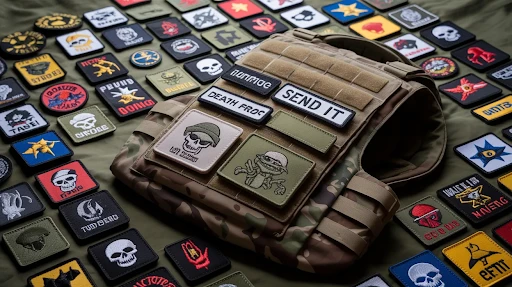
When you need patches that represent your unit, brand, team, event, or personality, custom Velcro patches are the answer. The American Patch produces fully custom hook-and-loop backed patches in every construction type, with domestic production and no minimum order requirements.
| Custom Option | Details |
| Custom embroidered Velcro patches | Your design is digitized and stitched in up to 15 thread colors, with military-grade hook-and-loop sewn to the back |
| Custom PVC Velcro patches | 3D molded soft PVC in full color with Velcro heat-sealed and sewn to the back, waterproof, and tactile |
| Custom Velcro morale patches | Your original art or approved design turned into a 2×3 morale patch, popular for unit gifting and collections |
| Custom name tape Velcro patches | Individual name tapes with Velcro backing for uniforms, any branch color, and font specification |
| Custom Velcro patches, no minimum | Order 1 patch or 10,000, same quality, same turnaround, same free digital proof process |
| Custom Velcro patches in USA | 100% domestic production, no overseas delays, union-quality standards, and full QC before shipping |
| Bulk Velcro morale patches | Volume pricing from 50 pieces; ideal for unit gifting, fundraisers, and gear shop inventory |
| Custom IR Velcro patches | Flag and unit identification patches with IR-reactive material, built to mil-spec dimensions |
How to Order Custom Velcro Patches from The American Patch
Submit your design or idea
Upload a logo file, a photo of a hand-drawn sketch, or simply describe your design. Our in-house digitizing team creates your artwork at no charge.
Review your free digital proof
We send a full-color mockup showing exactly how your patch will look before any thread is stitched or PVC is poured. Unlimited revision rounds until you’re satisfied.
Choose your specifications
Size, shape, thread colors (50+ Pantone-matched options), border style (merrow, hot cut, laser cut), and backing type, hook-and-loop, sew-on, iron-on, or combination.
Approve and go into production
Standard lead time: 10–14 business days. Rush production available. All patches are quality-checked before shipping.
Velcro Patches Care, Cleaning & Maintenance
Cleaning Velcro Hook Teeth (Most Important Maintenance Task)
Lint, thread, and fabric fibers lodging in the hook teeth are the primary cause of reduced Velcro grip. To clean:
Stiff brush method:
Use a stiff toothbrush, nail brush, or dedicated Velcro cleaning brush to sweep lint out of the hook side. Work in one direction along the rows.
Tape method:
Press a strip of duct tape or packing tape onto the hook side and peel away, it lifts lint and fibers efficiently.
Fine comb or seam ripper:
For a stubborn embedded thread, a fine-toothed comb or seam ripper tip can dislodge fibers without damaging the hooks.
Frequency:
Clean hook side every 3–5 washes for gear that sees daily use; monthly for occasional-use items.
Washing Gear with Velcro Patches Attached
- Best practice: Remove patches before washing. This prevents lint pickup and protects both the patch embroidery and the Velcro teeth.
- If washing with patches attached, close the Velcro (hook pressed to loop) and use a mesh laundry bag.
- Use cold or warm water, hot water degrades embroidery thread dyes and can warp PVC patches.
- Air dry or low heat in the dryer. High heat can delaminate Velcro adhesive and warp PVC.
- Never dry clean Velcro-backed items, solvents attack the hook-and-loop adhesive.
Storing Velcro Patches
- Store patches hook-to-loop or hook-in-pouch to protect teeth from lint accumulation.
- Flat storage in a binder with loop-side pages keeps collections organized and teeth protected.
- Avoid loose storage in drawers or pockets where the hook side can snag delicate fabrics.
Where to Buy Velcro Patches
Here’s how to evaluate quality before buying:
| Quality Factor | What to Look For | Red Flag |
| Velcro attachment method | Stitched Velcro to the patch back (perimeter stitching visible) | Glued-only Velcro will delaminate with use |
| Hook-and-loop density | Dense, stiff hook teeth; thick loop pile | Sparse hooks, floppy loop material, low grip strength |
| Embroidery coverage | 70–100% thread coverage; tight stitch density; clean merrow border | Thin embroidery with twill showing through; loose border stitching |
| PVC quality (if applicable) | Soft, flexible PVC; clean color separation; no bubbles in molding | Rigid, brittle PVC; blurry color edges; visible seam lines |
| Origin | USA-made or clearly specified quality production | Unknown origin with no quality specs or warranty |
| Size accuracy | Within 1/8″ of stated dimensions | Patches are significantly smaller or inconsistent with the product description |
Frequently Asked Questions
What are Velcro patches?
Velcro patches are patches embroidered, PVC, woven, or printed that feature a hook-and-loop (Velcro) fastener on their back. The hook side of the patch attaches to a loop panel on a hat, jacket, plate carrier, bag, or any loop-equipped surface, making the patch fully removable and reusable. They’re the standard for military uniforms, tactical gear, airsoft loadouts, and swappable hat and jacket patches.
Which side of the Velcro patches goes on the back?
The hook side (rough, scratchy) goes on the back of the patch. The loop side (soft, fuzzy) goes on the garment, hat, or gear panel. Easy memory tip: “hook on patch, loop on land.” Hook-on-garment would mean the rough side faces your clothing and skin, which causes snagging and discomfort. Hook-on patch is the universal industry standard.
Are Velcro patches removable and reusable?
Yes, completely. Velcro patches peel off in seconds and reattach instantly, thousands of times without losing hold. They’re designed specifically for this interchangeability. The patches themselves are reusable indefinitely as long as the Velcro hook teeth stay clean (free of lint and fabric fibers). The loop panel on the garment is equally reusable and long-lasting.
What are morale patches, and why are they used with Velcro?
Morale patches are unofficial, often humorous or motivational patches originally worn by US military personnel on their gear to build unit identity and boost esprit de corps. They use Velcro because the interchangeability is central to the culture, collectors rotate patches across their hats, bags, and plate carriers. The 2″×3″ Velcro-backed format has become the universal standard for morale patches worldwide.
What is the standard size for morale velcro patches?
The military standard, and by extension the morale patch community standard, is 2 inches × 3 inches (2×3). This size fits official US military uniform sleeve panels and the vast majority of hat loop fields. Other common sizes include 2×2, 3×3, and 4×2 (for name tapes). Most hat panels are designed to accept 2×3 patches; always check your hat’s panel dimensions before ordering.
Do Velcro patches work on a hat?
Yes, many tactical, military, and fashion caps now come with a built-in loop-side Velcro field on the front panel specifically for 2×3 patches. If your hat doesn’t have one, you can sew a loop-side Velcro square onto the front yourself (or take it to a tailor). For structured baseball caps, a sew-on loop panel is the most durable approach. Iron-on loop panels work on unstructured fabric hats.
How do you add Velcro to a patch that does not have it?
Three methods: (1) Sew-on Velcro, cut hook-side Velcro slightly smaller than your patch, pin it to the back, and sew around the perimeter using a zigzag stitch by machine or whip stitch by hand. Most durable. (2) Iron-on Velcro, use iron-on hook-and-loop tape, press firmly for 30 seconds, then reinforce with corner stitches. (3) Adhesive Velcro strips, peel-and-stick for low-stress display use only. See Section 10 for full step-by-step instructions for each method.
What is an IR velcro patch?
An IR (infrared) patch is made with retroreflective or photoluminescent material that appears as a normal fabric patch to the naked eye but glows brightly under night-vision devices (NVGs). IR American flag patches are standard issue for US military personnel, worn on the right shoulder, reverse-facing (stars to the front, stripes trailing). IR blood type and unit identification patches are also common on plate carriers and helmets. All IR patches use Velcro backing for field interchangeability.
Can you wash gear with Velcro patches?
It’s best to remove patches before washing to prevent lint from clogging the hook teeth. If you wash with patches attached, press the hook and loop closed, use a mesh laundry bag, and wash on cold or warm. Always air dry or use low dryer heat, high heat warps PVC patches and can delaminate Velcro adhesive. Clean hook teeth with a stiff brush after washing to restore grip.
How long do Velcro patches last?
Quality embroidered patches last essentially forever, the thread and twill construction doesn’t degrade under normal conditions. Quality hook-and-loop maintains over 90% grip strength for 10,000+ attachment cycles. The main maintenance requirement is keeping the hook teeth clean of lint, which is simple with a stiff brush. PVC patches are similarly long-lasting, soft PVC doesn’t crack or peel under normal use conditions.
Can I order custom Velcro patches with no minimum?
Yes! The American Patch offers custom Velcro patches with absolutely no minimum order. You can order a single custom morale patch for personal use, or place a bulk order of thousands for your unit, team, or brand. All orders receive a free digital proof before production begins, and all patches are produced domestically in the USA. Visit our custom patches page to get started.
What’s the difference between embroidered and PVC Velcro patches?
Embroidered Velcro patches are made from stitched thread on a twill base, lightweight, flexible, and traditional. PVC (rubber) Velcro patches are molded from soft rubber with a raised 3D texture, waterproof, more durable in wet conditions, and offer a distinctive tactile look. PVC patches are preferred for outdoor and tactical use; embroidered patches are preferred for official uniforms, professional insignia, and traditional aesthetics. Both use the same hook-and-loop backing system.
Where can I find Velcro patches near me?
Military surplus stores, tactical gear shops, gun shops, and sporting goods retailers often carry stock Velcro morale patches. For custom patches, online ordering from a USA-based supplier like The American Patch offers much broader customization, quality control, and no minimum quantities. If you need local sewing services to add a loop panel to a hat or jacket, tailor and alteration shops can help.
Are PVC patches better than embroidered patches for tactical use?
For wet, muddy, or rough field conditions, PVC patches have an edge, they’re 100% waterproof, easy to wipe clean, and the molded construction is virtually indestructible. For official uniform wear, formal insignia, and traditional aesthetics, embroidered patches remain the standard. Many military and tactical users carry both, embroidered for uniform wear, PVC for plate carriers, and bags. The American Patch makes both types with the same quality Velcro backing.
Can I put a Velcro loop panel on any jacket or bag?
Yes, a loop-side Velcro panel can be added to virtually any textile surface. Sew-on loop tape is the most durable approach for jackets, bags, and hats. Iron-on loop tape works on cotton and canvas for casual use. For leather and synthetic materials, sewing is the only reliable method. Once a loop panel is in place, any standard 2×3 or custom-sized hook-backed patch will attach and detach cleanly.
Build Your Velcro Patch Setup Starting Today
Velcro patches represent the perfect convergence of function and expression. From their military origins to mainstream fashion, from serious tactical identification to irreverent morale patch humor, hook-and-loop-backed patches are everywhere because they solve a real problem: how to make a permanent-looking patch that isn’t actually permanent.
Whether you’re outfitting a unit, building out a plate carrier setup, starting a morale patch collection, or simply adding some personality to your hat or bag, The American Patch makes it easy. Custom designs, no minimums, USA-made quality, and every backing option sew-on, iron-on, or hook-and-loop available on every patch type we produce.