
Velcro Patches for Backpacks: How to Attach, Add & Choose the Right Type
Velcro patches for backpacks are one of the easiest ways to personalize a bag without making a permanent change. You can add your name, logo, team identity, funny design, tactical patch, morale patch, school badge, or brand message and swap it whenever you want.
The best part is simple: if your backpack has a loop panel, you can press the patch on in seconds. If it does not, you can still add Velcro to the backpack using a sew-on loop panel, adhesive loop backing, or a carefully applied fabric-safe method.
In this guide, we’ll cover how Velcro backpack patches work, how to attach them properly, what to do if your bag has no Velcro area, which patch type is best, and how to choose the right size, backing, and material for daily use.
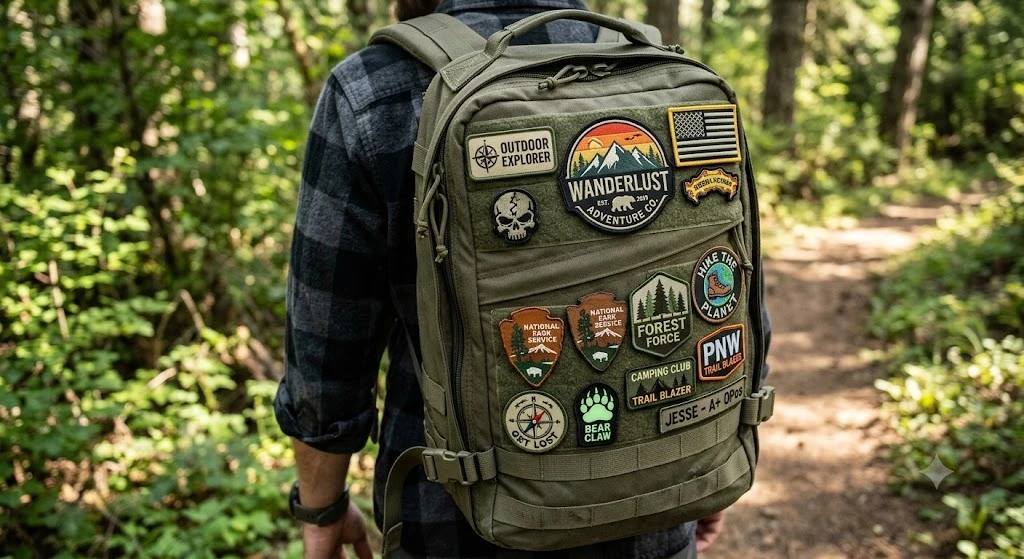
What Are Velcro Patches for Backpacks?
Velcro patches for backpacks are removable patches made with hook-and-loop backing. The patch usually has the hook side on the back, while the backpack needs a soft loop panel where the patch can attach.
Many people call them Velcro patches, but Velcro is actually a brand name for hook-and-loop fasteners. In simple words, the hook side grips the loop side when you press them together. When you want to change the design, you peel the patch off and replace it with another one.
That makes them perfect for:
- School backpacks
- Travel bags
- Tactical backpacks
- Laptop bags
- Work bags
- Sports bags
- Outdoor and hiking packs
- Brand promotional backpacks
- Military, police, and security gear
Unlike iron-on or sew-on patches, Velcro patches are not locked into one place forever. You get flexibility, customization, and clean removal.
Why Use Velcro Patches on Backpacks?
Velcro patches are popular because they solve three problems at once: style, identification, and flexibility.
A backpack is used almost every day. It goes to school, work, events, gyms, airports, hiking trails, and outdoor activities. Adding patches gives it personality without damaging the bag.
Here’s why people choose them:
- They can be changed anytime.
- They are better than stickers because they do not peel off after light use.
- They are cleaner than permanent marker or paint.
- They work well for names, logos, teams, clubs, and morale designs.
- They make bags easier to identify.
- They are useful for tactical and outdoor setups.
- They can be ordered in matching sets for groups or businesses.
For brands, Velcro patches can turn a simple backpack into mobile branding. For students, they help personalize school bags. For outdoor users, PVC Velcro patches are durable and easy to clean. For teams, name patches and role patches make identification simple.
How Do Velcro Patches Work?
Velcro patches work through a hook-and-loop system.
The hook side is rough and usually attached to the back of the patch. The loop side is soft and usually attached to the backpack. When the two surfaces press together, the hooks grab the loops and create a strong grip.
To remove the patch, you simply peel it away from one corner.
For best results:
- The loop panel should be clean.
- The patch should not be larger than the panel.
- The edges should be pressed firmly.
- The patch should sit flat without curling.
- The backpack surface should not bend too much under the patch.
If a patch keeps lifting from the corners, it usually means the panel is too small, dirty, worn out, or placed on a curved/folded area of the bag.
Types of Velcro Patches for Backpacks
Different patch types work better for different backpack uses. Choosing the right one depends on your design, budget, environment, and how much detail you need.
| Patch Type | Best For | Main Advantage |
| Embroidered Velcro patches | Logos, names, school bags, uniforms | Classic stitched look |
| PVC Velcro patches | Outdoor, tactical, rain, rough use | Waterproof and durable |
| Woven Velcro patches | Small text, detailed logos | Clean detail and thin finish |
| Chenille Velcro patches | School, varsity, fashion bags | Soft raised texture |
| Leather Velcro patches | Premium branding, lifestyle bags | Upscale and rugged look |
| Reflective Velcro patches | Night visibility, cycling, travel | Safety and visibility |
| Morale Velcro patches | Tactical, funny, personality designs | Easy to swap and collect |
| Name Velcro patches | Teams, kids, staff, travel | Clear identification |
Embroidered Velcro Patches for Backpacks
Embroidered Velcro patches are a great choice when you want a traditional patch look. They work well for names, simple logos, school badges, clubs, sports teams, and everyday backpack designs.
The raised thread gives the patch a premium stitched feel. If your design has bold text, clean shapes, and limited small details, embroidery is usually a strong option.
Best for:
- School backpacks
- Company logos
- Name patches
- Sports teams
- Clubs and groups
- Everyday personal designs
PVC Velcro Patches for Backpacks
PVC Velcro patches are better for outdoor, tactical, and weather-resistant use. They are made from flexible rubber-like material and can handle rain, dust, mud, and rough handling better than many fabric-based options.
If the backpack is used for hiking, camping, military-style gear, gym use, outdoor work, or travel, PVC is usually one of the best choices.
Best for:
- Tactical backpacks
- Outdoor bags
- Travel packs
- Military-style patches
- Morale patches
- Waterproof designs
- 3D logo patches
Woven Velcro Patches for Small Text
Woven Velcro patches are useful when your design has small letters, thin lines, or more detailed artwork. The surface is flatter than embroidery, so text can look cleaner.
They are a good choice for name patches, QR-style designs, small brand tags, and detailed logos.
Best for:
- Small text
- Clean typography
- Detailed logos
- Minimal backpack patches
- Thin profile designs
Velcro Name Patches for Backpacks
Velcro name patches are one of the most practical options. They help identify the owner of a bag and make group gear look more organized.
They are useful for:
- Students
- Sports teams
- Travel groups
- Employees
- Security staff
- Event crews
- Kids camps
- Military-style bags
For kids, name patches reduce lost-and-found problems. For teams and businesses, they create a clean uniform look. For travel, they make bags easier to recognize without permanently marking the backpack.
Morale and Funny Velcro Patches for Backpacks
Morale patches are popular because they let people show personality. Some are funny, some are motivational, some are tactical, and some are made around inside jokes, hobbies, or group identity.
They are commonly used on tactical backpacks, range bags, hiking packs, and casual streetwear-style bags.
Popular ideas include:
- Funny quotes
- Mascot patches
- Flag patches
- Mission patches
- Hobby patches
- Gaming patches
- Anime-inspired patches
- Team slogans
- Outdoor adventure patches
Because they are removable, collectors can rotate different designs depending on mood, trip, outfit, or event.
How to Put a Velcro Patch on a Backpack
If your backpack already has a loop panel, attaching the patch is very simple.
Step 1: Clean the Loop Panel
Dust, lint, hair, and fabric fibers can reduce grip. Use a lint roller, soft brush, or masking tape to clean the loop panel before attaching the patch.
Step 2: Place the Patch Carefully
Hold the patch above the panel and align it before pressing. Make sure the patch does not hang outside the loop area.
Step 3: Press From the Center Outward
Press the middle first, then move outward toward the edges. This helps the hooks grip evenly and keeps the patch flat.
Step 4: Check the Corners
Run your fingers over the corners and edges. If any part lifts, press it again. If the patch is too large for the panel, choose a smaller patch or add a bigger loop panel.
What If Your Backpack Does Not Have Velcro?
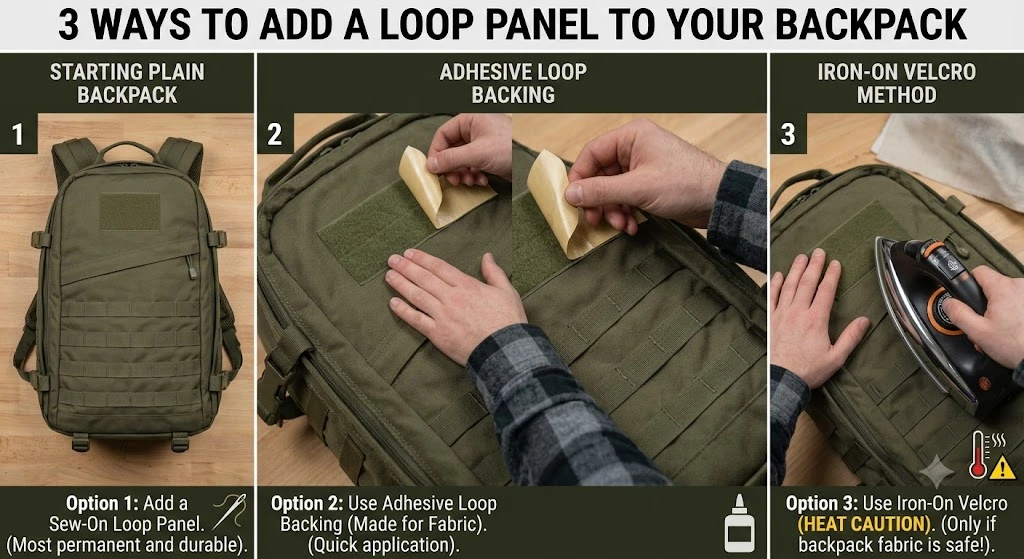
Many backpacks do not come with a built-in Velcro loop panel. That does not mean you cannot use Velcro patches.
You have three main options:
- Add a sew-on loop panel to the backpack.
- Use adhesive loop backing made for fabric.
- Use iron-on Velcro only if the backpack fabric can safely handle heat.
For heavy use, sewing is the strongest method. For light use, adhesive can work if the surface is clean, flat, and not too textured. For synthetic backpacks, be careful with heat because some materials can warp, melt, or become shiny.
How to Add Velcro to a Backpack
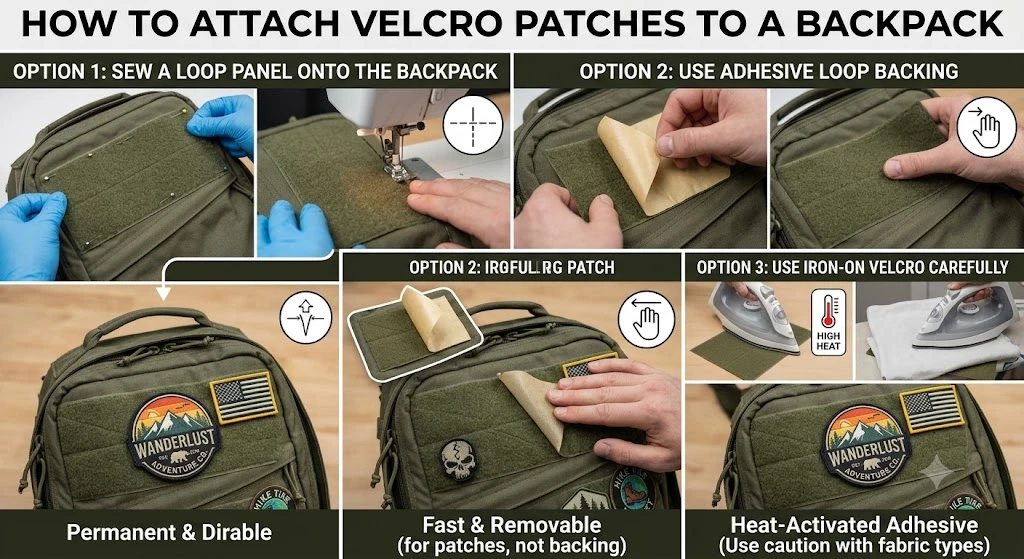
Adding Velcro to a backpack depends on the fabric and how permanent you want the setup to be.
Option 1: Sew a Loop Panel Onto the Backpack
This is the strongest method and the best option for long-term use.
Use this method for:
- School backpacks
- Tactical bags
- Outdoor packs
- Work bags
- Travel bags
- Heavy patches
- Daily-use backpacks
How to do it:
- Choose the loop panel size.
- Place it on a flat area of the backpack.
- Mark the edges lightly.
- Pin or tape it in position.
- Stitch around the border.
- For larger panels, add an X-stitch through the center.
This gives you a secure patch area that can handle repeated swapping.
Option 2: Use Adhesive Loop Backing
Adhesive loop panels are good when you want a no-sew option. They work best on smooth, flat fabric surfaces.
How to apply:
- Clean the backpack surface.
- Let it dry fully.
- Mark the placement.
- Apply the adhesive loop panel evenly.
- Press firmly.
- Place a heavy object over it if needed.
- Let it cure before attaching patches.
For better hold, add a few corner stitches after applying the adhesive panel.
Option 3: Use Iron-On Velcro Carefully
Iron-on Velcro can work on some fabric bags, but backpacks often use synthetic materials, coatings, foam layers, or water-resistant finishes. These may not handle heat well.
Before using heat, check the backpack material. If you are unsure, avoid ironing and choose sewing or adhesive instead.
Sew-On vs Adhesive vs Iron-On Velcro
| Method | Best For | Pros | Cons |
| Sew-on loop panel | Heavy use, outdoor, tactical, school bags | Strongest and long-lasting | Requires stitching |
| Adhesive loop panel | Light use and smooth surfaces | No sewing needed | May weaken over time |
| Iron-on Velcro | Heat-safe fabric bags | Clean look, quick application | Risky on synthetic materials |
| Adhesive + corner stitch | Medium to heavy use | Stronger than adhesive alone | Still needs some stitching |
For most backpacks, the best method is sew-on loop panel. If the customer wants convenience, adhesive can work for lighter use, but it should be placed on a clean and flat area.
How to Add Velcro to a Patch
If you already have a regular patch and want to make it removable, you can add hook backing to it.
The cleanest method is:
- Use hook backing on the patch.
- Use loop backing on the backpack.
- Attach the patch by pressing both sides together.
For embroidered patches, the hook backing can be stitched around the border. For PVC patches, the backing is usually attached during production. For iron-on patches, you can avoid ironing them onto fabric and instead convert them into Velcro patches by adding hook backing.
If you are ordering custom patches, it is better to request Velcro backing from the start. That gives a cleaner finish and stronger hold.
Can You Convert an Iron-On Patch to Velcro?
Yes, you can convert an iron-on patch to Velcro. Instead of ironing the patch directly onto the backpack, attach hook backing to the back of the patch.
Basic method:
- Do not iron the patch onto the bag.
- Attach hook backing to the patch.
- Use strong textile adhesive or stitching.
- Let the backing fully set.
- Press it onto a loop panel on the backpack.
This is useful if you already have iron-on patches but want the flexibility of a removable patch system.
Best Sizes for Backpack Velcro Patches
Patch size matters because a patch that is too large may curl at the edges or hang outside the loop panel.
Common backpack patch sizes include:
| Patch Size | Best Use |
| 2 x 1 inches | Small name patches, tiny icons |
| 2 x 3 inches | Flags, morale patches, compact logos |
| 3 x 3 inches | Round patches, mascots, symbols |
| 4 x 2 inches | Name tags, role patches, brand logos |
| 4 x 4 inches | Large statement patches |
| 5 inches and above | Big designs, but only for large panels |
For most backpacks, 2 x 3 inches and 4 x 2 inches are the safest and most popular sizes. They look clean without overpowering the bag.
Best Backpack Fabrics for Velcro Panels
Velcro panels work best when placed on firm, flat, non-stretch areas of the bag.
Good surfaces include:
- Canvas
- Cordura-style nylon
- Polyester backpack panels
- Tactical loop areas
- Flat front pockets
- Reinforced fabric sections
Avoid placing loop panels on:
- Stretchy fabric
- Thin mesh
- Curved seams
- Zippers
- Highly textured areas
- Areas that fold often
- Waterproof coatings that reject adhesive
If the backpack fabric is rough or coated, sewing the loop panel is safer than using adhesive only.
How to Keep Velcro Patches From Falling Off
A good Velcro patch should stay secure, but placement and maintenance matter.
To prevent patches from falling off:
- Use the right patch size.
- Keep the loop panel clean.
- Avoid overhanging edges.
- Press the patch firmly from center to corners.
- Use quality hook backing.
- Avoid placing patches on flexible fold areas.
- Add a tack stitch for high-value patches.
For travel, outdoor use, or crowded events, you can add one small corner stitch to prevent quick removal or theft while still keeping the patch mostly removable.
How to Clean Velcro Patches and Backpack Panels
Dust and lint can weaken the hook-and-loop grip. Regular cleaning helps the patch stay secure.
For the backpack loop panel:
- Use a lint roller.
- Use masking tape to lift fibers.
- Use a soft brush for dust.
- Remove hair or threads from the loops.
- For embroidered patches:
- Spot clean gently.
- Avoid harsh scrubbing.
- Air dry fully before attaching again.
- For PVC patches:
- Wipe with a damp cloth.
- Use mild soap if needed.
- Dry before storing.
Do not throw Velcro patches loose inside the backpack because the hooks can catch on fabric, thread, or other items.
Best Uses for Custom Velcro Patches for Backpacks
Custom Velcro patches are not only for decoration. They can be used for identity, branding, safety, and organization.
For Schools and Students
Name patches, class patches, club patches, and mascot patches make school backpacks more personal and easier to identify.
For Businesses and Events
Companies can use branded backpack patches for staff, trade shows, giveaways, campaigns, and promotional merchandise.
For Tactical and Outdoor Gear
PVC morale patches, flag patches, blood type patches, team patches, and identification patches are useful for rugged bags and tactical setups.
For Travel
Name patches, country patches, destination patches, and reflective patches make travel bags easier to spot.
For Sports Teams and Clubs
Teams can use patches for player names, roles, team logos, sponsors, and limited-edition gear.
PVC vs Embroidered Velcro Patches for Backpacks
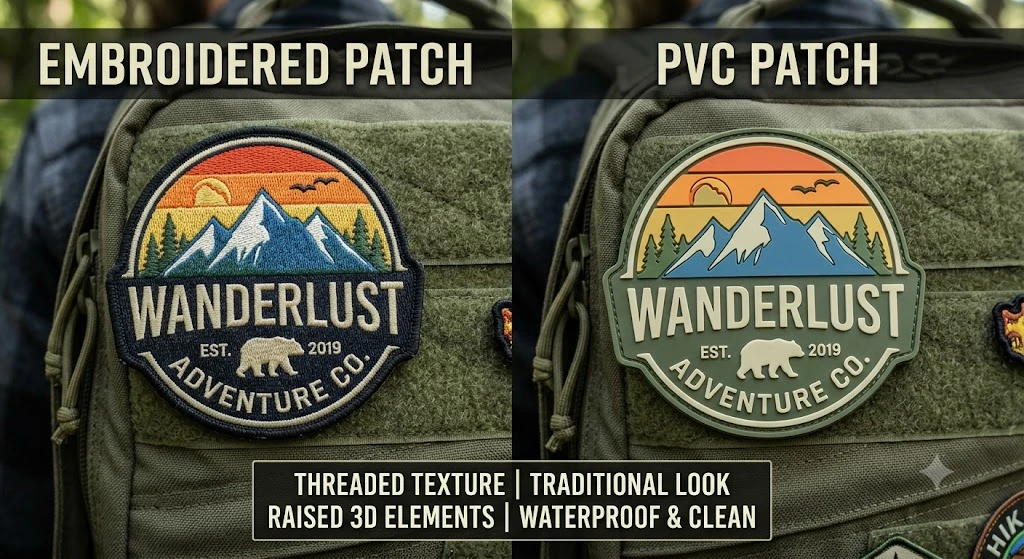
Both PVC and embroidered patches are good, but they serve different purposes.
Choose embroidered patches if you want:
- Classic stitched texture
- A premium traditional look
- Simple logos
- Name patches
- School or club patches
Choose PVC patches if you want:
- Water resistance
- Outdoor durability
- 3D detail
- Easy cleaning
- Tactical or rugged style
- Bold colors and shapes
For daily school or brand use, embroidered patches are excellent. For outdoor, tactical, rain, or rough handling, PVC is usually better.
Common Mistakes to Avoid
Many people order backpack patches without checking the placement area first. That can cause sizing or attachment problems.
Avoid these mistakes:
- Ordering a patch larger than the backpack loop panel.
- Using adhesive on dusty or coated fabric.
- Ironing synthetic backpack material without testing.
- Choosing embroidery for very tiny text.
- Choosing PVC for a design that needs fine thread texture.
- Placing the patch where the bag bends.
- Ignoring edge grip and corner lift.
- Washing patches while attached to the backpack.
A good custom patch starts with the right size, material, backing, and placement.
How to Order Custom Velcro Patches for Backpacks
When ordering custom Velcro patches, share these details with the patch maker:
- Patch size
- Patch shape
- Design or logo
- Preferred colors
- Material choice: embroidered, PVC, woven, chenille, leather
- Backing type: Velcro hook backing
- Quantity
- Backpack use: school, tactical, travel, event, outdoor, business
- Any special finish: reflective, glow, 3D, merrow border, laser cut
If you are not sure which material is best, send the design and intended use. A professional patch team can recommend the right patch type and backing.
FAQs About Velcro Patches for Backpacks
What are Velcro patches for backpacks?
Velcro patches for backpacks are removable hook-and-loop patches that attach to a soft loop panel on a bag. They can be swapped, removed, and replaced without permanently changing the backpack.
How do you put a Velcro patch on a backpack?
Clean the loop panel, align the patch, press it from the center outward, and check the corners. Make sure the patch fits fully inside the loop panel.
Can I use Velcro patches on a backpack without Velcro?
Yes. You can add a loop panel to the backpack by sewing it on, using adhesive loop backing, or applying iron-on Velcro if the fabric can safely handle heat.
What is the best way to add Velcro to a backpack?
Sewing a loop panel is the strongest method. Adhesive loop panels can work for light use, while iron-on Velcro should only be used on heat-safe fabric.
Can you glue Velcro to a backpack?
Yes, but it depends on the fabric. Adhesive works better on smooth, clean, flat surfaces. For heavy use, adhesive plus corner stitching is more reliable.
Can you add Velcro to an existing patch?
Yes. You can add hook backing to the back of an existing patch using stitching or strong textile adhesive. For the cleanest result, order custom patches with Velcro backing already attached.
Are PVC Velcro patches better than embroidered patches?
PVC patches are better for outdoor, tactical, and waterproof use. Embroidered patches are better for a classic stitched look, names, school bags, and simple logos.
What size Velcro patch is best for backpacks?
The most common sizes are 2 x 3 inches, 3 x 3 inches, and 4 x 2 inches. The best size depends on the loop panel area on the backpack.
How do I stop Velcro patches from falling off?
Keep the loop panel clean, choose the right size, press edges firmly, avoid overhanging corners, and use quality hook backing. For rough use, add a small tack stitch.
Can Velcro patches be washed?
It is better to remove Velcro patches before washing the backpack. Spot clean embroidered patches gently and wipe PVC patches with a damp cloth.
Upgrade Your Backpack With Custom Velcro Patches
Velcro patches for backpacks are practical, customizable, and easy to swap. Whether you need name patches for students, PVC patches for outdoor gear, morale patches for tactical bags, or branded patches for events, the right patch can make your backpack look more personal and professional.
At The American Patch, we create custom Velcro patches in embroidered, PVC, woven, chenille, leather, and specialty styles. Send us your design, logo, or idea, and our team will help you choose the best size, material, colors, and backing for your backpack patches.
Ready to customize your backpack? Get a quote today and create Velcro patches that are built to be seen, swapped, and remembered.