When you recently acquired a letterman jacket or are assisting a student in planning their own, there is a high chance you would ask the same question over and over again. How should I place my patches? There is nothing random about letterman jacket patch placement, and knowing how to properly do it will make all the difference in terms of appearance.
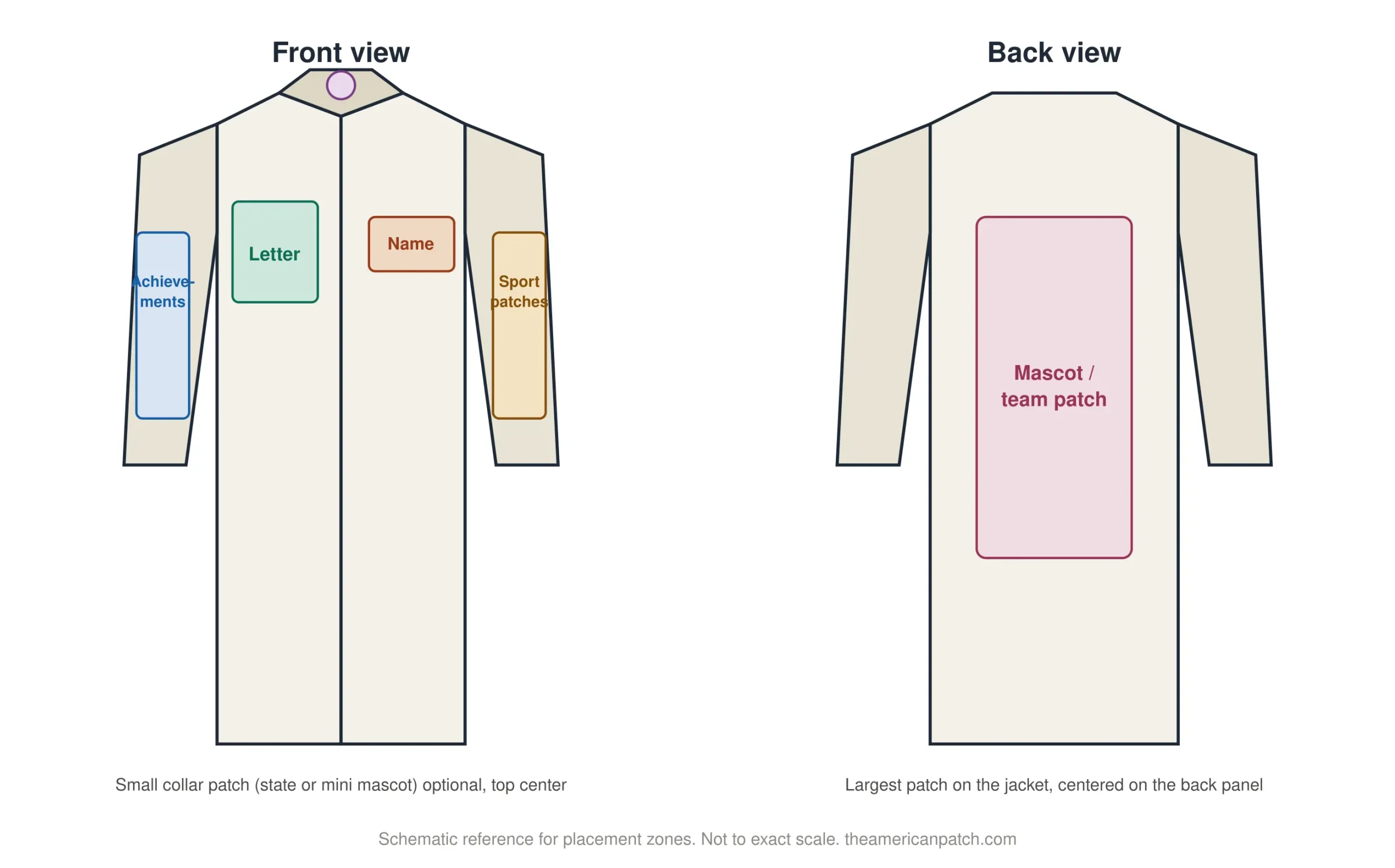
Quick answer: the varsity letter goes on the left chest, name or personal patches go on the right chest, achievement and activity patches go on the left sleeve, sport-specific patches go on the right sleeve, and the mascot or team patch goes on the back panel. Pins and bars are arranged around the varsity letter, not scattered across the jacket. The full breakdown below covers every zone, patch type, spacing, and school variation you need to plan before you sew anything.
This guide explains where each patch belongs, from the varsity letter and name patch to sleeves, pins, and back designs, along with a step-by-step look at planning your layout before you sew. You will find out everything you need to know about patch planning prior to sewing.
What Is a Letterman Jacket
In answering the question, what is a letterman jacket? A letterman jacket is an athletic jacket with a wool body and leather sleeves that some refer to as a varsity jacket. This jacket is awarded to students who make the varsity team.
The jacket ended up being a history book of sorts for each student. The body panels would have the name of the school or the mascot of the school printed on them, while the front, sleeves, and back panels would be designed to accommodate patches, letters, pins, and bars.
This is precisely why patch placement matters a great deal. Every section of the jacket has its own significance, and by knowing this significance, you help the jacket make sense rather than look like a bunch of custom patches put together randomly.
When planning varsity patch layouts for customers, one of the most common mistakes we see is ordering patches before creating a complete layout. Deciding on zones first, then ordering, saves far more rework than the other way around.
Recommended Spacing Between Patches
Placement zones tell you where a patch belongs, spacing determines whether the finished layout looks intentional or crowded. As a general starting point:
| Patch Area | Recommended Spacing |
| Chest patches (letter and name) | Leave 1 to 2 inches between the patch and the jacket seam or edge |
| Sleeve patches | Keep patches aligned with the seam direction, with roughly half an inch between stacked patches |
| Back patch | Center horizontally and vertically before sewing, leave visible margin from the collar and side seams |
| Collar or pocket trim | Use one small patch only, avoid stacking multiple pieces in this zone |
These numbers are a starting point for planning, not a fixed rule, always check actual fit against your jacket before committing to final placement. For more on how patch size interacts with different jacket zones, see our guide on custom patch sizing.
The Complete Letterman Jacket Patch Placement Guide
Here is where to put patches on letterman jacket panels, zone by zone, along with the answer to where patches go on the sleeves and the back.
Left Chest: The Varsity Letter
The left chest is where the big chenille varsity letter resides. Normally it is the first letter of the school’s name. This particular patch is the most distinctive feature of the whole jacket, which explains the very name letterman jacket. Most schools do not experiment with this position, since it is not really an area open for rearrangement.
Can the varsity letter go anywhere else? Traditionally, no. The left chest position is the standard because it is what identifies the jacket as a varsity award jacket in the first place, moving it elsewhere breaks that visual convention even if the jacket still looks tidy.
Right Chest: Name and Personal Patches
The right chest is the place where a student puts their name patch, whether the whole name or a nickname. The whole jacket is supposed to be symmetrical, the varsity letter on one side and a name or personal patch on the other. At times students choose an individual award patch to put there instead of the name patch.
Left Sleeve: Achievements and Time in the Program
Many schools use the left sleeve for smaller patches representing accomplishments outside the main sport, though exact placement traditions vary by program. Common additions include the year of graduation, additional sports patches, club or activity patches, and award patches. You may think of it as the timeline of a student’s achievements in other areas.
Right Sleeve: Sport-Specific Details
For the right sleeve, patches related specifically to the sport the letter represents typically go here. These include number patches, position patches, MVP or all-conference patches, and team captain patches. Keeping sport-related patches on the right sleeve and general patches on the left sleeve is a common way to keep a busy jacket from looking like a mess, though your school’s own guidelines take priority if they differ.
Back Panel: Mascot and Team Identity
As the largest free space on the jacket, the back panel can accommodate the largest patch. School mascot patches, team name patches, championship year patches, and custom back patches go here. Since this patch is the most visible part of the whole design, its size and centering play an important role in how it turns out. See our custom back patches options if you are planning a larger back design.
Collar and Pocket Trim
Miniature patches, such as state patches or a small mascot patch, are sometimes added to the collar area or the welt pocket edge. These are optional placements best used for one small patch rather than several, since crowding the neckline area makes the jacket look cluttered rather than detailed.
Example Letterman Jacket Layouts
Two common layouts show how the zones above come together in practice.
Football jacket: varsity letter with a football pin on the left chest, player’s name on the right chest, jersey number and captain patch on the right sleeve, graduation year and any club patches on the left sleeve, school mascot on the back.
Academic letter jacket: academic letter on the left chest, honor society patches stacked on the left sleeve, club or activity patches on the right sleeve, school emblem centered on the back.
Both follow the same zone logic, only the specific patches placed in each zone change based on what the letter actually represents.
Where Do Patches Go on a Letterman Jacket by Patch Type
If you want to know what patches can go on a letterman jacket, take a look at the chart below for the various types of letterman jacket patches, their meanings, and their placements.
| Patch Type | What It Represents | Where It Goes | Typical Size |
| Varsity letter | Main sport or activity | Left chest | 6 to 8 inches |
| Name patch | Wearer identity | Right chest | 2 to 4 inches |
| Number patch | Jersey number | Right sleeve | 1 to 2 inches |
| Year patch | Graduation or season year | Left sleeve | 1 to 2 inches |
| Mascot patch | School symbol or team identity | Back panel | 6 to 12 inches |
| State patch | Home state or region | Left sleeve or near collar | 1 to 2 inches |
| Activity or club patch | Extracurricular involvement | Left sleeve | 1 to 3 inches |
| Academic patch | Honor roll or academic award | Left sleeve or right chest | 1 to 3 inches |
| Captain patch | Team leadership role | Right sleeve | 1 to 2 inches |
| Championship patch | Tournament or season win | Back panel or right sleeve | 3 to 10 inches |
Letterman Jacket Pin and Bar Placement
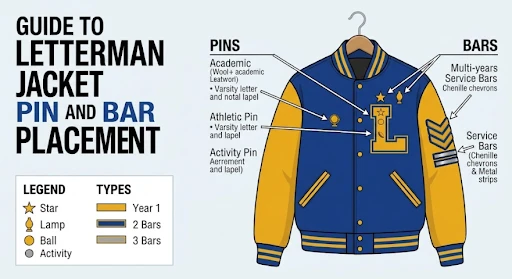
Pin and bar placement follows different rules than sewn patches, and this is one of the most frequent points of confusion for new letterman jacket owners. Traditionally, metal pins and bars are arranged around the varsity letter, often placed above the left chest letter or directly on the patch itself, rather than scattered across the jacket.
Service bars, representing a year the student was part of the team, are usually placed in a vertical or horizontal line, depending on the chosen layout, above or under the varsity letter. Sport pins, shaped like a small ball, racquet, or instrument, are typically clipped onto the letter patch to show which sport earned it.
The key rule for pin placement is consistency. Pins should form a straight, evenly spaced row rather than sitting at different angles, and they should not interfere with sleeve or back patches. A consistent arrangement above the varsity letter reads as intentional rather than accidental.
High School Letterman Jacket Patch Placement Rules
High school letterman jacket patch placement usually follows a stricter set of rules than a personal fashion jacket, especially for jackets awarded through the athletic department. Common school guidelines include:
The varsity letter stays on the left chest and is not typically moved to another panel.
Only school-approved patches, such as official sport, academic, or club patches, are allowed on the jacket.
Graduation year and captain patches often have an assigned sleeve so that every student’s jacket reads the same way.
Jackets are expected to stay legible from a distance, which usually means limits on how many patches can go on the front panels.
These conventions also shift somewhat by sport and activity, football and baseball letter jackets tend to follow the tightest, most traditional layouts, while cheer, band, and academic letter jackets sometimes allow more flexibility in sleeve arrangement. Placement traditions vary by school, so it is always worth confirming with your athletic department before sewing anything permanently.
When customizing a jacket outside of school guidelines, for instance a fashion letterman jacket with no relation to a sports team, there is more flexibility in how the design is arranged. Placing the varsity letter or main logo in the usual left chest position will still make the jacket read as a letterman jacket rather than just a bomber jacket.
Letterman Jacket Patch Placement Ideas
After all the required patches are installed, you still have room to personalize the jacket. These placement ideas work well for both a school-issued jacket and one you are building yourself, and they double as a starting point for students still deciding what to add.
Stack year patches on the left sleeve in chronological order so the jacket reads like a season-by-season timeline.
Use a single large custom back patch instead of several smaller ones for a cleaner, more premium look.
Add a small state patch near the collar for students who transferred schools or want to represent hometown pride.
Group sport-related patches on one sleeve and academic or club patches on the other for a clear, organized story.
Leave visible negative space between patches instead of packing them edge to edge, which makes even a heavily decorated jacket look curated rather than crowded.
Many athletes also keep adding to the jacket well after graduation, championship patches from alumni events, reunion patches, or personal milestone patches. If you expect to add pieces later, it is worth leaving a little planned space in the collar and sleeve zones now rather than filling every inch on day one.
Letterman Jacket Patch Planning Checklist
Before you order or sew anything, run through this list.
- Confirm your school’s placement rules, if the jacket is part of an official athletics program
- Measure the available space in each zone on the actual jacket
- Choose patch sizes that fit those measured zones, not just what looks good in a mockup
- Pin or tape a full layout in place and review it before committing
- Approve colors and artwork against your school or team colors
- Order all patches together for consistent thread weight and color matching
Custom Letterman Jacket Patches vs Regular Patches
If you need to decide between custom letterman jacket patches and regular stock patches, the answer comes down to detail and fit. Regular or stock patches are made in set designs, standard shapes, and common colors.
They work fine for anything generic that just needs a number or a year patch. Custom letterman jacket patches, on the other hand, are built exactly to the colors, fonts, and artwork of the school, team, or individual design.
Whenever something is specific to your school mascot, team logo, or a particular achievement, custom patches are the better route since they match the jacket exactly rather than approximating it with a generic design.
Custom patches also come with a defined backing type (iron-on, sew-on), thread weight, and border style built to hold up over years of wear, unlike many mass-produced stock patches. Our chenille patches page covers exactly this kind of varsity letter and mascot work in more detail.
How to Get Patches for Your Letterman Jacket
Knowing how to get patches made for your letterman jacket is a straightforward process once the placement is planned out.
Decide which patches are needed and where each one will go using the placement guide above.
Choose a patch style, such as chenille patches for large bold letters, embroidered patches for detailed logos, or woven for fine text.
Submit artwork or a design idea, including exact colors and sizing, to a custom patch maker.
Review a digital proof before production to confirm placement, size, and color accuracy.
Select a backing type, either sew-on for a permanent hold or iron-on for a faster application.
How to Put Patches on a Letterman Jacket
Knowing how to put patches on a letterman jacket the right way matters just as much as knowing where they go. Once you have the patches, there are a few ways to attach them.
Sew-on patches last the longest of all the options, which is why most varsity letter patches and back patches are sewn rather than ironed. Iron-on patches can be applied by heating and pressing them onto fabric, but this works better on cotton or denim than on wool letterman jackets.
For wool or leather letterman jackets specifically, sewing is the safer choice over ironing, since the heat and pressure involved in ironing can damage both wool and leather. Our full sew-on patches guide walks through the technique in more detail, including how to handle the wool body and leather sleeves separately.
Get Your Letterman Jacket Patches Made the Right Way
Creating a plan for placing each patch is just the beginning. You also need the patches themselves produced to the right sizes, colors, and backing options so they actually fit their designated positions.
The American Patch provides custom letterman jacket patches, including varsity letters, mascot patches, name patches, and sleeve patches made to your exact school colors.
About The American Patch
The American Patch has over a decade of experience producing custom chenille, embroidered, and varsity jacket patches for schools, teams, and organizations across the United States, with no minimum order requirement. Every order includes a free digital proof before production, so nothing is stitched until the design, colors, and sizing are confirmed.
Build a Layout Before You Sew Anything
Before deciding on sewing or ironing any patch onto your jacket, fit each one onto the actual jacket first. Attach each patch using pins or temporary tape at its intended position.
Stand back and take a good look at whether everything is even on both sides, how far apart the patches sit from one another, and whether they are square to the seams. This step alone saves most people from having to redo the whole layout later.
Common Mistakes to Avoid in Patch Placement
Overcrowding one panel while leaving another mostly empty, which throws off the visual balance of the jacket.
Choosing a patch size that is too large or too small for its zone, which makes even a well-placed patch look out of proportion.
Ignoring school rules on approved patch types and required placement, which can lead to a jacket being sent back for correction.
Placing patches at an angle instead of squared to the seam lines, one of the easiest mistakes to spot from across a room.
Mixing too many patch styles, like chenille, woven, and PVC, on the same jacket, which can make the overall look feel inconsistent.
Skipping patch care after placement is finished, which shortens how long the finished layout actually looks good.
Need Help Planning Your Jacket?
Not sure how many patches your jacket can realistically fit, or how to balance the layout across zones? Share your jacket style, school colors, and patch ideas, and our team can help put together a balanced layout before anything goes into production.
Frequently Asked Questions
Where do patches go on a letterman jacket?
Varsity letter on the left chest, name on the right, achievement patches on the left sleeve, sport-specific patches on the right sleeve, mascot patch on the back, and pins arranged above the letter patch.
What is the correct high school letterman jacket patch placement?
High schools typically require the varsity letter on the left chest, allow only approved patches, and set their own rules about placement and quantity. Always check with your athletic department, since traditions vary by school.
Where do letterman jacket pins and bars go?
Pins and bars are traditionally arranged around the varsity letter, often above or directly on it, marking service years and activities in a tidy row on the jacket’s front panel.
How do I put a letter on a varsity jacket?
The varsity letter is typically sewn onto the left chest of wool and leather jackets and serves as the anchor point for additional patches. Professional sewing is recommended for secure, lasting placement, especially on leather sleeves.
Does placement differ by sport or activity?
The core zones stay consistent, but some schools apply slightly different sleeve conventions for football, baseball, cheer, band, or academic letter jackets. Confirm with your athletic department if your program has its own variation.
Can I add patches to my letterman jacket after graduation?
Yes, many people continue adding patches for alumni events, championships, or personal milestones well after graduation. Leaving a bit of planned space in the collar and sleeve zones during the original layout makes this easier later.
How many patches should a letterman jacket have?
There is no universal limit, but most well-designed jackets balance the required patches with enough open space to keep the design readable rather than cluttered.
Order a Full Custom Patch Set for Your Jacket
Planning letterman jacket patch placement before attaching a single patch turns a haphazard group of patches into an organized record of a student’s achievements.
The varsity letter sits on the left chest, the name on the right. Achievements and sport info go on the sleeves, and the back displays the largest design. Pins and bars go around the letter, and school policy should always be checked first if the jacket is part of an official athletics program.
With the layout planned in advance, every patch finds its right place. Browse letterman jacket patches and order your complete patch set at The American Patch.
When ordering custom patches for an entire letterman jacket at once, including the varsity letter, the back mascot, and sleeve patches, having all patches made together helps keep color and thread weight consistent across the full set.
Contact us today to inquire about ordering patches and receive a complimentary quote for your patch order. Send in your school colors, mascot artwork, and list of patches needed, and our team will help you get a layout that fits.