
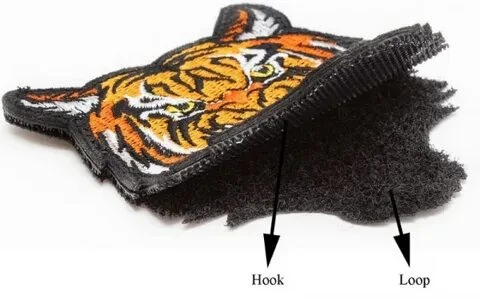
A hook and loop patch is any patch embroidered, PVC, woven, printed, leather, or chenille — with a rough “hook” fastener sewn to its back, designed to attach to a soft “loop” panel on a backpack, uniform, hat, or tactical vest. Press it on, it grips. Peel it off, it releases. No sewing, no heat, no adhesive residue.
We’ve produced hook and loop backing on tens of thousands of patches at The American Patch, and it’s now the single most requested backing option for anything tactical, uniform-related, or backpack-mounted. This guide covers everything we explain to customers before they order: which side goes on the patch, what the backing actually costs, standard sizes, and the mistakes that make patches fall off.
Quick Answer: Which Side Goes Where?
| Component | Feel | Where It Goes |
| Hook side | Rough, scratchy, stiff | Back of the patch |
| Loop side | Soft, fuzzy | On the garment, bag, or gear |
| Patch face | Your design | Faces outward |
The rule we tell every customer: hook on the patch, loop on the location. Reverse it and the setup technically still grips, but a permanent rough hook panel on clothing snags fabric, scratches skin, and fills with lint within weeks. We’ve re-done orders for customers who learned this the hard way.
Where “Hook and Loop” Came From (And Why It’s Not Called Velcro)
The technology was invented in 1941 by Swiss engineer George de Mestral, who examined burdock burrs stuck to his dog’s fur under a microscope and noticed tiny hooks catching in the fur’s loops. He patented the design in 1955 and founded what became Velcro Companies.
Here’s the part that matters when you’re ordering:
- VELCRO® Brand is a registered trademark — a company name, like Kleenex or Xerox.
- Hook and loop is the generic name for the technology itself.
Most patches on the market — including most “Velcro patches” you see advertised — use generic hook and loop fastener, not genuine VELCRO® Brand material. That’s not a quality problem; high-grade generic hook and loop performs comparably. But if a supplier claims VELCRO® Brand specifically, ask for confirmation. We describe our backing as hook and loop unless a customer specifically orders branded material, because that’s the honest description.
How the Fastening Actually Works
Each square inch of hook material carries hundreds of small, stiff nylon or polyester hooks. The loop side carries a dense pile of flexible loops. Press them together and the hooks catch inside the loops, creating strong resistance against shear force (sideways sliding) while still allowing peel release from an edge.
That distinction — strong in shear, weak in peel — is why the system works so well for patches. A patch on a backpack mostly experiences sideways drag and vibration (shear), which the fastener resists easily. When you want it off, you peel from a corner, which the fastener releases willingly.
Quality hook and loop fastener is rated for roughly 10,000 open/close cycles before the grip meaningfully degrades. In practice, the loop panel usually wears out before the hook backing does — crushed, lint-filled loops are the most common reason a patch “stops sticking,” not a failed patch.
Types of Hook and Loop Patches (With Honest Trade-offs)
The backing is the same across all of these. What changes is the patch construction on the front — and each one suits different artwork and conditions.
| Patch Type | Best For | Strength | Watch Out For |
| Embroidered | Uniforms, unit insignia, classic logos | Traditional raised stitch texture | Fine details under 0.25″ get lost |
| PVC | Tactical gear, outdoor, wet conditions | Waterproof, wipeable, 2D/3D molding | Heavier; stiff on curved caps |
| Woven | Small text, detailed crests | Finest detail of any thread patch | Flat — no raised texture |
| Printed | Photos, gradients, complex art | Unlimited color | Least traditional look; fades faster in sun |
| Leather | Premium bags, hats, lifestyle brands | Rugged upscale finish | Limited to debossed/engraved detail |
| Chenille | Varsity, school, fashion | Soft raised pile | Too bulky for small loop panels |
| Reflective | Night visibility, safety roles | Visibility under headlights | Limited design treatment |
| Name tapes | Workwear, uniforms, bags | Instant identification | Narrow format only |
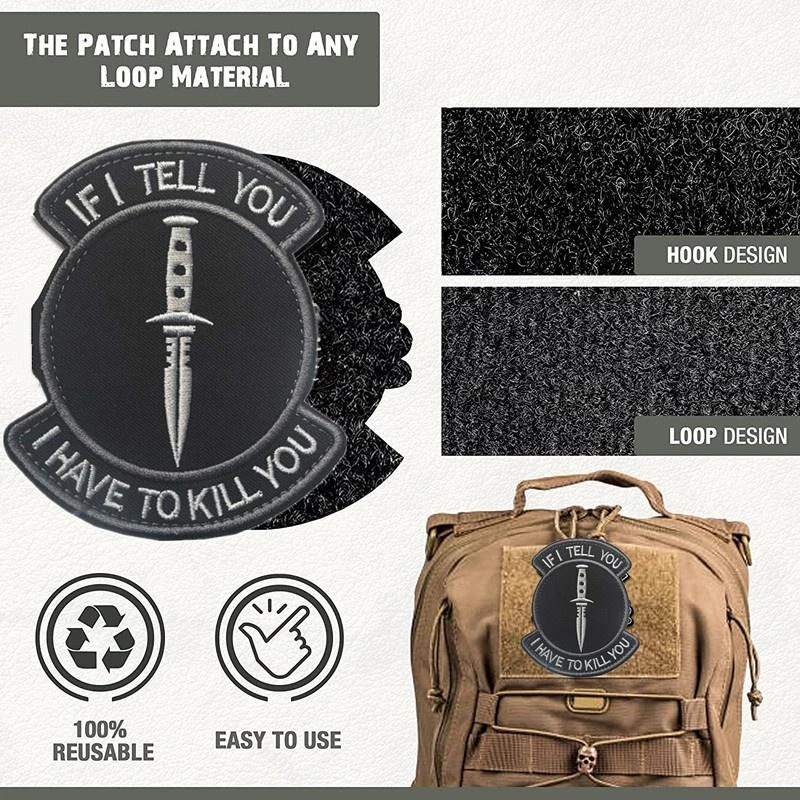
Our production-floor rule of thumb: if the design has lettering smaller than a quarter inch, go woven, not embroidered. Embroidery thread physically can’t resolve text that small — it turns into a blob. This is the most common artwork problem we fix at the proofing stage.
Standard Sizes and What They Fit
Customers ask “what size should my patch be” more than any other question. These are the sizes we produce most, and what they typically fit:
| Size | Typical Use |
| 1″ × 4″ | Name tapes, uniform strips |
| 2″ × 3″ | Standard tactical/morale patch — fits most backpack loop panels |
| 3″ × 2″ | Flag patches, shoulder placement |
| 3″ × 3″ | Round/square morale patches, plate carriers |
| 3.5″ × 2.25″ | Standard cap front panel |
| 4″ × 4″ and up | Back patches, large display pieces |
The one measurement rule that prevents 90% of problems: measure your loop panel first, and order the patch at least a quarter inch smaller on every side. A patch that overhangs its panel has unsupported edges — and unsupported edges curl, catch, and peel. Measure the usable flat area only; don’t count rounded corners or stitched borders.
What Do Hook and Loop Patches Cost?
Pricing depends on size, material, quantity, and backing coverage, but here’s the realistic range so you can budget (custom patches, per-piece, as of 2026):
| Quantity | Embroidered 3″ | PVC 3″ |
| 50 pcs | ~$3–5 each | ~$4–6 each |
| 100 pcs | ~$2–3.50 each | ~$3–4.50 each |
| 300+ pcs | ~$1.50–2.50 each | ~$2–3.50 each |
Hook and loop backing typically adds $0.20–$0.50 per patch over standard sew-on backing, depending on whether you need the matching loop piece included. A few things move the price: 3D molding on PVC, metallic thread, more than 9 thread colors, and rush production.
If you want exact numbers for your design, request a free quote — we return a digital proof and firm pricing before anything goes to production, so there are no surprises.
Hook and Loop Patches for Backpacks
Backpacks are the most common destination for these patches, and most tactical, school, and outdoor bags now ship with a built-in loop panel — usually on the front face or lid.
Before ordering, check three things on your bag:
- Does the panel feel soft and fuzzy? That’s loop material, and a hook-backed patch will grip it. If the panel feels rough, it’s hook material (rare, but some budget bags get this backwards) and you’d need loop backing instead.
- Measure the flat usable area — excluding seams, curved corners, and any zipper that passes underneath.
- Is the area flat when the bag is loaded and unloaded? A panel that collapses when the bag empties will flex your patch off over time.
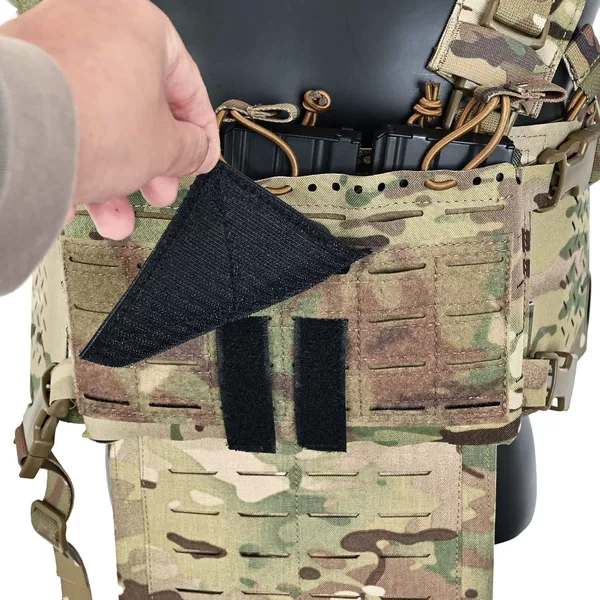
MOLLE webbing is not a loop panel. A common mistake: tactical bags covered in MOLLE (the horizontal webbing rows) don’t automatically accept hook-backed patches. You need an actual loop field, or a MOLLE-mounted loop adapter panel.
If Your Backpack Has No Loop Panel
Three ways to add one, ranked by how well they actually hold up:
Sewn-on loop panel (best). A tailor stitches loop material around its full perimeter. This is the only method we recommend for bags that get daily use. Works on nylon, polyester, and canvas. Watch for internal linings and waterproof layers before stitching.
Adhesive loop panel (temporary only). Peel-and-stick loop works on smooth, rigid, clean surfaces — a display board, a locker door. On flexible textured bag fabric, the adhesive fails within weeks even though the hook-loop grip itself is fine. We hear this complaint constantly: “my patch fell off” almost always means “my adhesive panel fell off.”
Heat-applied loop panel (rarely). Only if both the bag material and the panel instructions explicitly allow heat. Synthetic bag fabrics and waterproof coatings melt or delaminate easily. When in doubt, sew.
Hook and Loop vs Sew-On vs Iron-On
| Feature |
Hook & Loop |
Sew-On | |
| Removable |
✔ Yes |
✘ No | ✘ Usually no |
| Reusable elsewhere |
✔ Yes |
✘ No |
✘ No |
| Survives heavy washing attached |
Remove first |
✔ Best |
Moderate |
| Works on heat-sensitive fabric |
✔ Yes |
✔ Yes |
✘ No |
| Needs existing loop panel |
✔ Yes |
✘ No |
✘ No |
| Best for rotating names/roles |
✔ Excellent |
✘ Poor |
✘ Poor |
Choose hook and loop when identification changes (names, ranks, event roles), the item already has a loop field, or you rotate designs on one bag.
Choose sew-on when the placement is permanent, the garment gets industrial washing, or you don’t want a visible panel left behind.
Choose iron-on when you need fast one-time application on flat, heat-safe fabric and the patch will never move.
How to Attach a Hook and Loop Patch (The Right Way)
- Clean both surfaces. Pull lint, hair, and thread out of the hook backing and brush the loop panel. A lint-filled hook surface is the #1 cause of weak grip.
- Dry-fit first. Lay the patch on the panel without pressing. Confirm every edge sits inside the loop field and the design is straight.
- Anchor one edge. Press the top edge down first — this stops the patch from drifting crooked.
- Press outward from that edge. Firm hand pressure across the center, borders, and every corner.
- Tug-test the corners. If a corner lifts immediately, your patch is bigger than the panel, or the loop pile is worn flat.
Why Patches Fall Off (Troubleshooting Table)
| Problem | Real Cause | Fix |
| Corners keep lifting | Patch bigger than the panel | Smaller patch or larger panel |
| Grip feels weak | Lint packed into hooks | Clean hooks with tweezers or a stiff brush |
| Falls off curved surface | Rigid patch on flexing area | Move to a flat zone; choose thinner construction |
| Backing separates from patch | Glued-only backing, no stitching | Order stitched perimeter backing |
| Whole panel peels off bag | Adhesive panel failing | Sew the panel on |
| Snags other clothes in the wash | Patch left on during washing | Always remove before washing |
That last one deserves emphasis: remove hook and loop patches before washing. Exposed hooks in a wash cycle act like a lint magnet and will chew delicate fabrics in the same load. The garment washes normally; the patch gets wiped or spot-cleaned according to its material — damp cloth for embroidered and woven, soap and water for PVC, leather cleaner for leather.
Who Uses These Patches (And What For)
Military and tactical. Removable unit insignia, rank, flags, and IR (infrared) identifiers on plate carriers, field jackets, and range bags — swappable between assignments without altering the gear. Our morale patches are almost exclusively ordered with hook backing.
Law enforcement and first responders. Department, role, and medical-function identifiers on police and EMS uniforms — always subject to agency uniform policy.
Companies with rotating staff. One set of uniform patches, interchangeable name and department tags. The garment outlives every staffing change.
Schools, teams, and events. Coach/volunteer/staff identifiers reused across seasons, and hat patches on caps with built-in loop fronts.
Collectors. Loop boards and display panels let a patch collection be rearranged endlessly without pins or glue.
Ordering Checklist: What to Tell Your Patch Maker
Send these eight things and you’ll get an accurate quote and a patch that actually fits:
- Artwork, logo, or even a rough sketch
- Exact width × height (measured from your loop panel, minus ¼” margin)
- The specific item it’s going on (“3-day assault pack front panel” beats “backpack”)
- Patch material preference — or ask for a recommendation based on the artwork
- Quantity
- Whether you need the matching loop piece included
- Full or partial hook coverage (full is right for anything wearable)
- Deadline
One detail most buyers miss: confirm whether the listing includes both sides. “Hook-backed patch” means the rough backing only — if your gear has no loop panel, you need the loop piece supplied too, or the patch has nothing to grab.
Frequently Asked Questions
Are hook and loop patches the same as Velcro patches?
Functionally yes, legally no. VELCRO® Brand is a trademark; hook and loop is the generic technology most patches actually use. Both work the same way.
Do hook and loop patches stick to regular fabric?
No — not reliably. The hooks need a proper loop pile to grab. Fleece and some fuzzy fabrics catch temporarily, but the patch will slide off in use.
How long does the backing last?
Quality fastener is rated around 10,000 attach/release cycles. The loop panel on your gear usually wears out first — crushed or lint-filled loops are the typical failure point.
Can I wash a garment with the patch attached?
Remove the patch first. Exposed hooks collect lint and snag other items in the load. Wash the garment normally, clean the patch separately by material.
Can an existing patch be converted to hook and loop?
Usually yes — hook material gets stitched to the back around its perimeter. Very thin patches, narrow borders, and old adhesive backings make conversion harder. Ordering hook backing at production is always cleaner.
Is full hook backing better than partial?
For anything worn or carried, yes. Partial center-only backing leaves edges unsupported, and unsupported edges lift. Partial is only adequate for flat indoor displays.
What size fits a standard backpack loop panel?
Most tactical and school backpack panels accept a 2″ × 3″ patch comfortably. Measure yours — panels vary, and the patch should sit at least ¼” inside every edge.
Hook and loop is the right backing whenever a patch needs to move — between assignments, between bags, or just out of the way before laundry day. If you’re ready to make one, send us your artwork, the size, and the item it’s going on. Get a free digital proof and quote — we’ll recommend the right material, backing coverage, and loop-panel setup before a single patch is stitched.