Hells Angels patches aren’t simply decorative. The club’s colors can communicate membership, chapter affiliation, and loyalty, along with a handful of small lettering patches whose meanings are disputed outside the club.
The most recognizable configuration is the three-piece back patch: the “HELLS ANGELS” top rocker, the Death Head center emblem, and a geographic bottom rocker. Other symbols, including 81, AFFA, and the 1% diamond, carry their own meanings.
This guide separates well-documented meanings from claims found in court records, law-enforcement sources, and biker-culture reporting, because not every patch meaning circulating online is publicly confirmed or universal across chapters.
A quick note: the Hells Angels Motorcycle Corporation owns registered trademarks on its name, the Death Head logo, and related marks in multiple countries. This article is written for cultural, historical, and educational purposes. It is not a template for reproducing protected club insignia, and none of the information here is intended to help anyone impersonate, provoke, or misrepresent an outlaw motorcycle club.
What Are Hells Angels Patches?
The sleeveless leather or denim vest that members wear in motorcycle club culture is called a “Hells Angels cut,” short for “cut-off,” because early bikers literally cut the sleeves off old jackets to keep them cool and free of burden on long rides.
The best-documented Hells Angels configuration is a three-piece back patch consisting of a top rocker, Death Head center emblem, and bottom rocker identifying the member’s territory. Exact details can vary by charter, country, and period. Federal court records describe this configuration directly.
The traditional three-piece patch set consists of:
- Top rocker patch — the curved patch across the shoulders that reads “HELLS ANGELS” in the club’s signature red-on-white lettering.
- Center patch — the iconic winged skull, known as the Death Head logo, positioned in the middle of the back.
- Bottom rocker patch — the curved patch beneath the Death Head that identifies the member’s chapter location, such as a city, state, or country.
Together, this three-piece configuration forms the Hells Angels back patch, the large, unmissable design worn across the back panel of the vest.
On front panels, smaller patches, pins, and lettering are added over years of membership, each one representing a specific achievement, role, or milestone within the motorcycle club hierarchy.
It’s worth understanding this structure because it’s the same logic that governs club insignia across the wider world of outlaw motorcycle clubs, not just this one organization. A motorcycle vest, or MC vest, is read almost like a uniform patch system: rank, chapter, and reputation are all visible at a glance to anyone who understands biker culture.
Hells Angels Symbols Explained: The Core Set
These are the core symbols the club has used consistently since the 1950s and 1960s.
The Death Head Logo
The Death Head is a skull wearing an aviator-style helmet with wings, facing forward. The design has been the club’s central emblem since its early history in the 1950s.
The Hells Angels Motorcycle Corporation has pursued trademark litigation against multiple companies over unauthorized commercial use of skull-and-wings imagery similar to the Death Head. Court filings describe the Death Head as a registered collective membership mark.
The Number 81
81 is a numeric code used instead of the letters: H is the eighth letter of the alphabet and A is the first, so 8 and 1 together stand for Hells Angels. An official charter FAQ confirms this explanation.
The exact use of 81 breaks down into a few related but distinct ideas:
- 81 as a coded reference to the Hells Angels name.
- “Support 81” as merchandise or apparel worn by associates and supporters who are not full members. Court records describe this use by associates.
- 81 as a registered trademark, since the club’s own trademark litigation identifies it as a source identifier for the organization. See the trademark complaint.
Because of that overlap, seeing “81” on someone’s gear doesn’t by itself confirm whether the wearer is a full member, since the Death Head and full club name are reserved for patch holders who have completed the membership process.
AFFA
AFFA is commonly expanded as “Angels Forever, Forever Angels,” a phrase associated with lifelong loyalty to the Hells Angels once a rider becomes a full member. This idea of long brotherhood over individual interest appears repeatedly across the club’s patches, tattoos, and public statements.
One Percenter Patch
The diamond-shaped one percenter patch, usually displaying “1%” or “1%er,” is commonly traced to a 1947 comment suggesting that 99 percent of motorcycle riders are law-abiding, leaving one percent who embrace an outlaw identity — though that origin story is repeated far more often than it is independently documented.
The diamond-shaped 1% symbol is associated with the “one-percenter” identity adopted by some outlaw motorcycle clubs, and Hells Angels members have been documented wearing it.
Other Common Abbreviations
In addition to the core symbols, riders will also encounter shorthand such as FTW (an anti-establishment phrase meaning rejection of authority) and other acronyms unique to individual chapters. These smaller marks add texture to the overall patch story but bear far less formal weight than the Death Head, rockers, 81, and AFFA.
| Symbol | What It Reads / Shows | General Meaning |
| Death Head | Winged skull, center back | Core club emblem and registered trademark |
| Top Rocker | “HELLS ANGELS” | Confirms club name; only for full members |
| Bottom Rocker | Chapter/city name | Identifies the wearer’s home charter |
| 81 | Numeric H-A code | Public support symbol, used by non-members and merchandise |
| AFFA | Angels Forever, Forever Angels | Lifelong loyalty pledge |
| 1% / One Percenter | Diamond shape with “1%” | Self-identification as an outlaw rider |
The Filthy Few and Dequiallo Patches
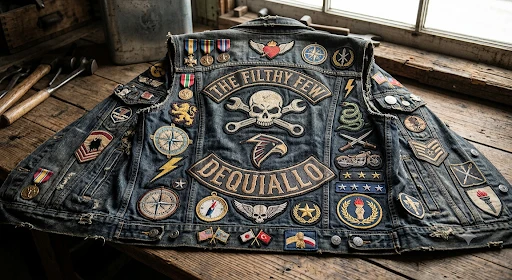
A handful of small lettering patches are worn only by select members, and their meanings have been debated in legal proceedings as much as in biker bars. Not every patch meaning discussed online is confirmed — the sections below distinguish what’s documented from what’s disputed.
Filthy Few Patch Meaning
The meaning of the Filthy Few patch is disputed. It is an extremely rare mark within the Hells Angels. Court records have documented testimony and government allegations connecting it with violence committed on behalf of the club, while the club’s own public position describes it as a symbol of extreme dedication rather than anything unlawful. Court testimony on this point has been reported by CaseMine. Because there is no publicly available Hells Angels rulebook establishing a universal definition, the meaning should not be presented as settled fact.
Dequiallo Patch
The Dequiallo patch is documented in law-enforcement notices and court proceedings. Court proceedings in the Netherlands have described the patch as associated with resistance or violence toward police or other government authorities. It is regarded as one of the more serious patches a member can wear, since it references a clash with law enforcement. Investigators sometimes point to its presence as a sign of a highly active or high-risk member of the group.
Hells Angels War Patch Meaning
In a broader sense, any small lettering patch given for severe deeds performed in support of or defense of the club — whether against other clubs, police enforcement, or other perceived threats — falls within this category. These patches are reported to be given to a select group of members whose history within the organization is deemed extraordinary by the club’s internal criteria, not for regular membership.
Patches Commonly Confused With Hells Angels Symbols
Not every patch associated with outlaw-motorcycle culture belongs to the Hells Angels specifically. These three terms are frequently searched alongside Hells Angels patches, but the evidence behind each is weaker or points to a different club entirely.
Expect No Mercy — most widely documented as a patch associated with the Bandidos Motorcycle Club rather than the Hells Angels. It’s included here because it sits in the same wider family of confrontational, police-defying themed patches as Dequiallo, and people researching one patch often look for the other.
Omertà — refers to the broader Sicilian code of silence long associated with organized crime, and it appears in the vocabulary of outlaw motorcycle clubs more generally, including groups such as the Bandidos. There isn’t reliable, Hells Angels-specific documentation confirming it as an officially recognized Hells Angels achievement patch, so it’s best understood as part of the wider outlaw-biker vocabulary rather than a confirmed club-specific mark.
Men of Mayhem — a phrase popularized partly through television drama about outlaw motorcycle clubs. It’s sometimes associated with outlaw-biker imagery, but there is no reliable, Hells Angels-specific documentation establishing it as an official club patch meaning, and it shouldn’t be treated as an established fact without primary sourcing.
Masters of Menace — a regional or chapter-level term without a single, widely accepted definition. As with several terms above, meanings can change over time and between charters, and there is no strong Hells Angels-specific documentation confirming a fixed meaning.
None of these are officially documented by any club — their reported meanings are assembled from court cases, law-enforcement gang bulletins, and journalism, not a published rulebook, and definitions can vary by chapter, country, and decade. Treat a one-sentence definition as the most reported interpretation, not an absolute fact.
Hells Angels Hierarchy and Ranks
The Hells Angels have a motorcycle club hierarchy, as is common among outlaw motorcycle clubs generally. Understanding the hierarchy explains why not everyone wearing club colors holds the same standing or reputation.
| Stage | What public records indicate |
| Hang-around | Early, informal association with a charter; no official patch |
| Prospect | Probationary stage before full membership; some records describe prospects wearing only the bottom rocker |
| Full-patch member | Full member entitled to wear the complete three-piece back patch |
| Charter officers | Leadership roles such as president, vice-president, sergeant-at-arms, secretary, treasurer, and road captain — documented in federal court material |
An individual accepted into a club’s circle but not yet elected as a full member is usually identified by a Hells Angels prospect patch as being in a probationary phase. Before being allowed to wear the entire three-piece back patch, prospects are expected to show loyalty, dependability, and dedication over time.
This tiered ranking system is one of the key characteristics of outlaw motorcycle club culture worldwide, and it exists in part to protect the value and standing associated with full membership.
Hells Angels Patch Placement on the Vest
The three-piece back patch (top rocker, Death Head, bottom rocker) occupies the full back panel; this combination is the Hells Angels back patch in its most literal sense.
Small achievement and rank patches, including 1%, AFFA, and role-specific lettering, are commonly placed on the front panels, usually near the chest or lapel area. Chapter-specific pins, city bars, and years-of-service numerals are often added around the edges of the front panels over time.
For identification purposes, the back of a full-patch Hells Angels cut is generally recognizable by its three-piece configuration, and it’s rarely crowded with other symbols. Exact placement conventions for smaller front-panel patches can vary by charter, and unauthorized reproduction of club marks raises separate trademark and social issues, covered below.
What Does 13 Mean in Hells Angels, and Other Numbers Riders Ask About
A common outlaw-biker question is, “What does 13 mean in Hells Angels?” The number 13 is a recurring motif in MC culture, and there are a few competing explanations for it. Some relate it to the 13th letter of the alphabet, M, which has in the past been read as a drug reference.
In broader motorcycle-club culture, 13 is often interpreted through M, with different sources associating it with marijuana, motorcycle, or other meanings. It should not automatically be interpreted as a specific Hells Angels code, and the meaning can vary from region to region and chapter to chapter, as with several patches already covered above.
Members and long-time associates sometimes carry tattoos that mirror patch imagery, such as Death Head ink or AFFA lettering. Unlike a patch, a tattoo can’t be handed back, so it’s often read as an even more permanent declaration of membership.
Is It Legal to Wear Hells Angels Patches?
This question has two separate parts: trademark law, and social or physical risk. They shouldn’t be treated as the same issue.
Is the Hells Angels logo trademarked?
Yes. The Hells Angels Motorcycle Corporation has asserted registered trademark rights in the Hells Angels name, the Death Head design, and the “81” mark in the US and several other nations, with rights dating back decades to common-law use and formal registration. The organization’s trademark complaints document these claims, and it has pursued litigation against companies that used similar skull-and-wings imagery for commercial purposes, including a case involving copyright and trademark infringement claims.
Is wearing a patch illegal?
There is no universal yes-or-no answer. Trademark law generally concerns specific unauthorized uses of a protected mark, especially commercial use such as manufacturing and selling lookalike merchandise. Wearing a costume version of a patch for personal, non-commercial use raises different questions than manufacturing and selling lookalike items professionally, and the legality of either depends on jurisdiction and circumstances. This isn’t legal advice, and anyone with a specific situation should consult a qualified attorney.
Is it safe to wear one?
This is separate from trademark law entirely. On the social level, non-members wearing the specific three-piece set of Hells Angels back sew-on patches, or a close approximation of them, is widely regarded within biker culture as a serious affront to the club, and outlaw motorcycle clubs have a documented history of responding to imitators. In general, the informal rules across clubs are simple: colors and rockers are earned, not bought or borrowed, and shouldn’t be worn with any regularity or visibility in communities where actual club members are likely to be present.
Why Hells Angels Symbols and Biker Vest Patches Matter Beyond One Club
Even for people with no connection to outlaw biker clubs, this way of displaying identity is worth understanding. Motorcycle patches on a vest function as signs of status and rank, similar in purpose to military insignia, school letterman jackets, or corporate logos — a form of visual shorthand that communicates years of effort and recognition instantly. The standardized version of these signs tells more about a member’s history within the group than words alone could.
Hells Angels Patch Terms at a Glance
| Term | Category | Quick Meaning | Confidence |
| Death Head | Core symbol | Winged skull center patch, the club’s core logo and registered trademark | High |
| Top / Bottom Rocker | Core symbol | Club name and chapter location patches | High |
| 81 | Support symbol | Numeric code for “Hells Angels” (H=8, A=1) | High |
| AFFA | Loyalty symbol | “Angels Forever, Forever Angels” | High |
| 1% / One Percenter | Identity symbol | Self-identification as an outlaw rider | High |
| Filthy Few | Achievement patch | Extreme loyalty distinction; court records associate it with violence in some contexts | Medium |
| Dequiallo | Achievement patch | Court-documented association with resistance/violence toward police | Medium–High |
| Men of Mayhem | Disputed term | Popularized by TV drama; not reliably documented as an official club patch | Low |
| Omertà | Disputed term | Broader outlaw-culture code of silence; not confirmed Hells Angels-specific | Low |
| Masters of Menace | Regional term | Chapter-level term without a single accepted definition | Low |
| 13 | Numeric symbol | Multiple reported meanings across MC culture; not a confirmed Hells Angels code | Low/variable |
Frequently Asked Questions
What do Hells Angels patches mean?
Each patch on a member’s vest represents an earned status: club identity (the Death Head and rockers), public support (81), a loyalty pledge (AFFA), outlaw self-identification (the 1% diamond), or a specific, often disputed, personal achievement within the club (Filthy Few, Dequiallo, and similar lettering patches).
What does 81 mean in Hells Angels?
81 is a numeric substitution for the club’s initials: H is the 8th letter of the alphabet, and A is the 1st, so 81 stands for Hells Angels. It’s commonly used on support merchandise by people who back the club without being full members.
What does AFFA stand for?
AFFA stands for “Angels Forever, Forever Angels,” a phrase representing the club’s core message of permanent, lifelong loyalty once someone becomes a full member.
What is the Filthy Few patch?
The Filthy Few patch is a rare distinction within the Hells Angels. Court testimony from multiple U.S. racketeering cases has argued it marks members involved in serious violence for the club, while the club’s own public stance describes it as a symbol of extreme dedication. The precise meaning remains disputed.
What is the Men of Mayhem patch?
Men of Mayhem is a phrase associated with outlaw-biker culture and popularized partly by television portrayals of motorcycle clubs. There’s no reliable, club-specific documentation establishing it as an official Hells Angels distinction.
What does the Omerta patch mean?
Omertà refers to the broader code of silence associated with organized crime and outlaw motorcycle-club culture generally. There isn’t reliable documentation confirming it as an officially recognized Hells Angels-specific patch.
Is it illegal to wear Hells Angels patches?
It depends on context and jurisdiction. The club holds registered trademarks on its name and Death Head design, so commercial reproduction and sale of look-alike merchandise can trigger legal action. Wearing an unauthorized copy of the actual club colors also carries serious social and physical risk within biker culture, independent of trademark law. This isn’t legal advice.
Why are Hells Angels patches important?
They function as a visual record of identity, rank, chapter, and reputation. Within the club and wider biker culture, a vest’s patches are read much like a uniform, letting other riders understand who someone is and what they’ve done within the organization.
How are Hells Angels patches arranged on a vest?
The three-piece back patch (top rocker, Death Head, and bottom rocker) covers the back panel and is rarely crowded by other symbols. Smaller achievement, rank, and support patches are placed on the front panels and edges, following placement conventions that are broadly consistent but can vary by chapter.
What do biker patches symbolize?
Among outlaw and traditional motorcycle clubs, biker patches represent the prestige of the club, an individual member’s status, achievements, chapter, and region. Their specific icons and meanings differ, but their purpose is similar: signaling history and status at a glance.
Key Takeaways
- The best-documented Hells Angels symbol is the three-piece back patch: top rocker, Death Head, bottom rocker.
- 81, AFFA, and the 1% diamond are well-documented, though 81 doesn’t by itself confirm full membership.
- Filthy Few and Dequiallo have court-record attribution but disputed precise meanings.
- Men of Mayhem, Omertà, and Masters of Menace lack reliable Hells Angels-specific documentation and shouldn’t be treated as confirmed club rules.
- Wearing club colors involves separate trademark and social-risk questions — this article isn’t legal advice.
Sources consulted include the Hells Angels Motorcycle Corporation’s own trademark litigation filings, federal court records, a Dutch Supreme Court record, and reputable reporting. Because patch meanings can vary by charter, country, and era, interpretations without primary documentation are identified as disputed rather than presented as settled fact.
Need Custom Patches for Your Own Club or Brand?
Whether you’re outfitting a legitimate riding club with custom motorcycle patches, a veteran organization, a sports team, or a business that wants professionally made PVC patches or embroidered designs, our team builds fully custom patches to order, with no minimum order quantity and free digital proofs before production. Reach out for a free quote and we’ll help you design something built to last.