Hook and loop patches attach to soft loop panels without permanent sewing or heat. Learn which side goes on the patch, how the fastening system works, and which patch type is best for backpacks, uniforms, hats, and tactical gear.
A patch does not have to be permanently sewn onto one jacket, backpack, or uniform.
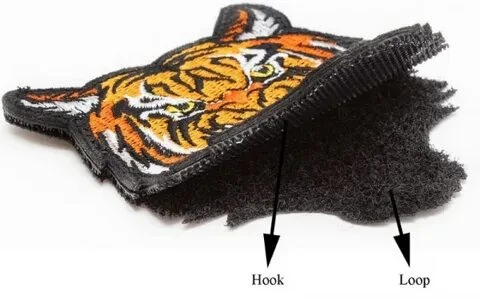
Hook and loop patches use a two-part fastening system that allows the patch to be attached, removed, and replaced whenever needed. The patch normally carries the rough hook backing. The garment or gear carries the soft loop panel.
Press both surfaces together and the hooks catch inside the loops. Peel the patch from one edge and the two sides separate again.
This removable setup is commonly used for:
- Backpacks
- Tactical gear
- Work uniforms
- Hats
- Jackets
- Sports bags
- Name patches
- Identification patches
- Morale patch collections
- Event and team apparel
The benefit is not simply convenience. A hook and loop system lets one surface support several interchangeable patches without repeatedly sewing, ironing, or applying adhesive.
Quick Answer
A hook and loop patch is a fabric, embroidered, woven, printed, leather, chenille, or PVC patch fitted with a rough hook backing.
It attaches to a separate soft loop panel placed on a backpack, uniform, jacket, hat, vest, or display board.
The correct setup is normally:
| Component | Texture | Normal Position |
|---|---|---|
| Hook side | Rough and scratchy | Back of the patch |
| Loop side | Soft and fuzzy | Garment, bag, hat, or gear |
| Patch face | Decorative or identifying design | Faces outward |
The system is mechanical rather than adhesive. Small hooks catch inside flexible loops when the two surfaces are pressed together. Official guidance from Velcro Companies identifies hook and loop as the generic name for this two-sided fastening system.
What Is a Hook and Loop Patch?
A hook and loop patch is a removable patch with fastening material attached to its back.
Unlike a sew-on patch, it is not permanently stitched directly onto the final garment. Unlike an iron-on patch, it does not need to be heated every time it is moved.
The patch attaches to a compatible loop panel already present on the item.
This makes it useful when:
- Names or roles change
- Different patches share one placement
- A patch must be removed before washing
- Uniform identification changes between assignments
- A backpack is personalized with rotating designs
- Tactical equipment uses different unit or role markers
- Collectors want to display and rearrange patches
The visible patch can be made from several materials. Hook and loop describes the backing system, not the decorative construction on the front.
An embroidered patch, PVC patch, woven patch, leather patch, or printed patch can all use hook backing.
Hook Fastener Patch Meaning
The phrase hook fastener patch meaning usually refers to a patch that has the rough half of a hook and loop system attached to its back.
The word “hook” describes the small, stiff structures covering that backing. When the patch is pressed onto a soft loop panel, those hooks catch inside the loops and create a reusable grip.
A hook-backed patch cannot attach properly to ordinary fabric by itself. It needs a compatible loop surface.
This distinction matters when ordering.
A listing that says only “hook-backed patch” may include the rough patch backing but not the separate soft loop panel. Ask whether both sides are supplied when your garment or bag does not already have a loop field.
Is Hook and Loop the Same as Velcro?
People often use “Velcro” as a general name for this type of closure, but that is not technically correct.
VELCRO® Brand is a registered trademark. Hook and loop is the generic name of the fastening technology. Not every hook and loop product is made by Velcro Companies.
For accurate product descriptions:
- Say hook and loop patch for a general patch using this backing.
- Say VELCRO® Brand hook and loop fastener only when genuine branded material is confirmed.
- Do not describe an unverified third-party product as a VELCRO® Brand product.
This wording is more accurate for buyers and avoids creating expectations about a branded component that may not be included.
How Hook and Loop Patches Work
The fastening action happens through physical contact between two surfaces.
The hook side
The hook side feels rough, firm, and slightly abrasive.
It is usually cut to match the patch shape and secured to the back through perimeter stitching, bonding, or a combination of production methods.
This side normally stays on the patch.
The loop side
The loop side feels soft and fuzzy.
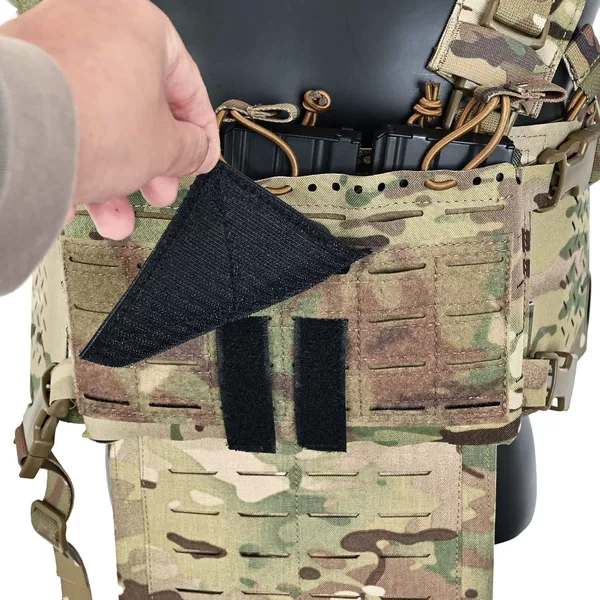
It is attached to the backpack, jacket, uniform, hat, tactical vest, pouch, or display panel.
This side receives the hook-backed patch.
What happens when they meet
When pressure is applied, numerous small hooks catch inside the flexible loops. This creates resistance against sideways movement while still allowing the patch to be peeled away from an edge.
The rough side is officially called the hook side, while the fuzzy surface is the loop side.
Which Side Goes on the Patch?
The rough hook side normally goes on the back of the patch.
The soft loop side goes on the item that will carry it.
This orientation is preferred for practical reasons:
- The soft panel is more comfortable on clothing.
- An exposed loop panel is less likely to snag nearby fabric.
- The rough hooks stay covered while the patch is attached.
- Multiple hook-backed patches can share the same loop field.
- The item remains usable when the patch is removed.
Technically, reversed surfaces can still grip one another. The result is less practical because a rough hook panel permanently placed on clothing or a bag may catch fibers, scratch skin, and collect debris.
Use this simple rule:
Hook on the patch. Loop on the location.
What Are Loop Patches?
The phrase loop patches can be confusing because people use it in more than one way.
Some buyers use “loop patch” as a casual name for any removable hook and loop patch. Others mean a patch that specifically has soft loop material on its back.
These are not always the same product.
Before ordering, confirm:
- Does the patch have rough hook backing?
- Does it have soft loop backing?
- Is a separate loop panel included?
- Will the patch attach to an existing loop field?
- Which side is already installed on the garment or backpack?
For most uniforms, bags, and tactical gear, order the patch with hook backing because the item normally carries the loop panel.
What Does “Patches Hook and Loop” Mean in Product Listings?
The wording patches hook and loop usually means that the patches are supplied with removable fastening material instead of plain sew-on or heat-seal backing.
The listing should still explain whether it includes:
- Hook backing attached to the patch
- A separate matching loop panel
- Full or partial backing coverage
- Sew-on or adhesive loop material
- Genuine branded or generic fastening material
Do not rely on the phrase alone. Backing orientation and included parts affect whether the patch will work with your intended item.
Main Advantages of Hook and Loop Patches
They are removable
The patch can be peeled off without cutting stitches or reheating adhesive.
This is useful for rotating designs, changing names, or removing identification when it is no longer required.
They are reusable
A properly made patch can be attached to another compatible loop panel.
The same patch may move between a backpack, jacket, hat, vest, or display board when each item has suitable loop material.
They simplify washing
A removable patch can be taken off before a garment or bag is cleaned.
This protects decorative thread, printed details, PVC surfaces, and exposed hook material from unnecessary washing.
They support changing roles
Names, ranks, departments, event roles, team assignments, and job functions can change.
A permanent patch requires alteration. A hook-backed patch can be swapped in seconds.
They work with different patch materials
The backing can be added to:
- Embroidered patches
- PVC patches
- Woven patches
- Printed patches
- Leather patches
- Chenille patches
- Reflective patches
- Name tapes
- Identification patches
They reduce permanent changes
A sewn loop panel remains on the item, but the visible design is not permanently fixed.
That gives users more flexibility than stitching every patch directly to the garment.
Possible Limitations
Hook and loop patches are practical, but they are not the right choice for every project.
They need a compatible panel
A hook-backed patch will not grip normal fabric reliably.
The item must already have a loop panel, or one must be added.
Exposed hooks collect lint
When the patch is removed, the rough hook backing can collect fibers, hair, thread, and dust.
A dirty hook surface may not grip as firmly.
Corners can lift
A patch may lift when:
- It is larger than the loop panel
- It sits on a curved area
- The backing does not reach the edges
- The loop surface is worn
- The patch is too rigid for the item
- The panel contains lint or debris
The loop panel remains visible
When the patch is removed, the soft panel stays on the garment or bag.
This may not suit formal clothing or minimalist designs.
It is less permanent than direct sewing
For a patch that will never be removed, direct perimeter stitching may provide a simpler and more permanent solution.
Types of Hook and Loop Patches
The best patch material depends on the design, environment, and intended use.
| Patch Type | Best For | Main Strength | Main Limitation |
|---|---|---|---|
| Embroidered | Uniforms, teams, names, traditional logos | Classic raised stitching | Very small details may be difficult |
| PVC | Outdoor gear, tactical bags, wet conditions | Easy to wipe and weather-resistant | Thicker and heavier |
| Woven | Small text, detailed logos, thin patches | Fine detail and clean lines | Less raised texture |
| Printed | Photographs, gradients, complex colors | High visual detail | Less traditional patch texture |
| Leather | Premium bags, hats, lifestyle branding | Rugged and upscale appearance | Fewer color and detail options |
| Chenille | Varsity, school, fashion applications | Soft raised texture | Bulky for small panels |
| Reflective | Night visibility and role identification | Increased visibility under light | Limited design treatment |
| Name tape | Uniforms, workwear, bags | Clear identification | Usually narrow in shape |
Embroidered hook and loop patches
Embroidery gives a patch visible thread texture and a familiar uniform-style finish.
It works well for:
- Company logos
- Team emblems
- Unit insignia
- Name patches
- Club patches
- School designs
Choose embroidery when the artwork has bold shapes, readable lettering, and a manageable amount of detail.
PVC hook and loop patches
PVC patches are molded rather than stitched.
They suit:
- Tactical backpacks
- Outdoor bags
- Plate carriers
- Rain-exposed gear
- Sports equipment
- Bold 2D or 3D designs
PVC is especially useful when the patch may be exposed to moisture, mud, or frequent handling.
Woven hook and loop patches
Woven patches use finer threads than traditional embroidery.
They are better for:
- Small lettering
- Thin lines
- Detailed crests
- Compact logos
- Lightweight uniforms
- Narrow name strips
The flatter construction also makes them comfortable on lighter garments.
Printed hook and loop patches
Printed patches are suitable when the artwork contains:
- Color gradients
- Photographic elements
- Detailed illustrations
- Many color transitions
- Complex backgrounds
They offer visual freedom but do not provide the same stitched texture as embroidery.
Leather hook and loop patches
Leather patches create a premium, rugged appearance.
They are commonly used on:
- Lifestyle backpacks
- Work bags
- Outdoor gear
- Branded caps
- Jackets
- Premium merchandise
A hook backing allows the leather design to remain removable instead of being permanently stitched onto one product.
Hook and Loop Patches for Backpacks
Hook and loop patches for backpacks are one of the most practical uses of this backing system.
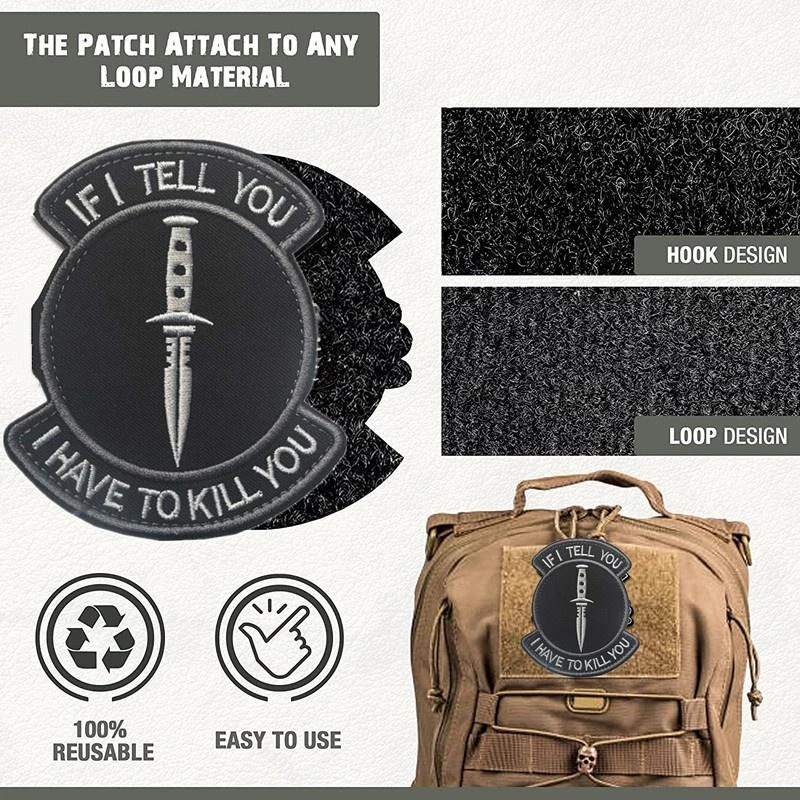
Many tactical, travel, school, and outdoor bags include a soft loop panel on the front. A hook-backed patch can be pressed directly onto that area and replaced without modifying the rest of the bag.
Common backpack patch uses include:
- Owner names
- Emergency information
- Team logos
- School identities
- Unit insignia
- Travel markers
- Funny or morale designs
- Company branding
- Event roles
- Reflective identifiers
The American Patch already has a dedicated backpack guide explaining materials, sizes, attachment methods, and what to do when a bag has no existing loop field.
Check the backpack first
Before ordering, examine the bag.
A built-in loop panel should feel soft and fuzzy. Measure its usable width and height without including seams or rounded corners.
The patch should fit fully inside the panel.
Keep the patch slightly smaller than the panel
A patch that extends beyond the loop area will not grip at the edges.
Those unsupported corners can curl, catch on objects, or peel away during use.
Leave a small visible margin around the patch whenever possible.
Avoid areas that fold
Do not place a rigid patch over:
- A zipper bend
- A pocket opening
- A curved side panel
- A compression strap
- A heavily padded fold
- An area that collapses when the bag is empty
A flat area provides more even contact.
Press the full surface
Start at the center and press outward toward the edges.
Check each corner before using the bag.
A patch that is only pressed in the middle may look attached while its border remains loose.
What If the Backpack Has No Loop Panel?
A loop panel can be added, but the attachment method matters.
Sew-on loop panel
This is the strongest choice for most fabric backpacks.
A tailor or experienced sewer can stitch the loop material around its perimeter without relying on adhesive.
It works well for:
- Nylon bags
- Polyester backpacks
- Canvas packs
- School bags
- Tactical bags
- Travel bags
Take care around linings, internal pockets, waterproof layers, and padding.
Adhesive loop panel
Peel-and-stick loop material may work for temporary display or a smooth, low-flex area.
It is less dependable on:
- Textured fabric
- Curved panels
- Flexible bags
- Dusty surfaces
- Water-resistant coatings
- Frequently handled areas
Adhesive may lift even when the hook and loop connection itself remains strong.
Heat-applied loop panel
Only use heat when both the backpack material and loop-panel instructions permit it.
High temperature may damage synthetic fabric, waterproof coatings, padding, or internal layers.
When the bag construction is uncertain, sewing is safer.
How to Attach a Hook and Loop Patch
When the item already has a loop panel, attachment is simple.
Step 1: Inspect both surfaces
Check the patch backing and loop panel for:
- Lint
- Hair
- Loose thread
- Dust
- Bent corners
- Worn sections
Clean them before attachment.
Step 2: Confirm the fit
Place the patch over the panel without pressing it down.
Make sure:
- Every edge sits within the loop field
- The design is straight
- No seam passes under the patch
- The panel is large enough
- The patch does not block a zipper or pocket
Step 3: Align one edge
Start with the top or side edge.
Careful alignment prevents repeated pulling and repositioning.
Step 4: Press across the surface
Press from the aligned edge across the patch.
Apply even hand pressure to the center, border, and corners.
Step 5: Test the hold
Gently move the item and inspect the edges.
If a corner lifts immediately, check the panel size, cleanliness, shape, and backing coverage.
Full Hook Backing vs Partial Hook Backing
Hook material can cover the full back of a patch or only part of it.
Full backing
The hook surface reaches close to the entire patch border.
This is generally better for:
- Large patches
- Frequent removal
- Irregular shapes
- Flexible gear
- Backpacks
- Tactical use
- Patches with pointed corners
Full backing helps distribute holding pressure across the design.
Partial backing
A smaller hook section sits in the center of the patch.
It may be adequate for:
- Small lightweight patches
- Temporary displays
- Flat indoor panels
- Designs that are rarely moved
Partial backing can allow unsupported edges to lift, especially on larger or stiffer patches.
For most wearable or backpack applications, full hook backing is the safer recommendation.
Hook and Loop vs Sew-On vs Iron-On Patches
| Feature | Hook and Loop | Sew-On | Iron-On |
|---|---|---|---|
| Removable | Yes | No | Usually no |
| Reusable on compatible panels | Yes | No | No |
| Needs heat | No | No | Yes |
| Needs sewing | Loop panel may need sewing | Yes | No |
| Best for changing identification | Excellent | Poor | Poor |
| Best for permanent placement | Good but removable | Excellent | Moderate |
| Works on heat-sensitive items | Yes, with sewn panel | Yes | Not always |
| Easy to remove before washing | Yes | No | No |
| Visible panel after removal | Yes | No | No |
Choose hook and loop when:
- The patch needs to change
- The item already has a loop panel
- Names or roles rotate
- The patch should be removable before washing
- One design will move between several compatible items
Choose sew-on when:
- The placement is permanent
- The garment receives heavy washing
- No visible loop panel is wanted
- The item is leather or heavy fabric
- Maximum long-term security matters
Choose iron-on when:
- Fast application matters
- The fabric safely tolerates heat
- The patch will remain in one location
- Sewing is not preferred
- The garment has a smooth, flat surface
How to Choose the Right Hook and Loop Patch
Start with the intended item
Tell the patch maker whether the patch will be used on:
- Backpack
- Tactical vest
- Work uniform
- Hat
- Jacket
- Sports bag
- Display panel
- Children’s bag
- Travel gear
- Event clothing
The intended surface affects size, material, flexibility, and backing coverage.
Measure the loop field
Do not estimate from a photograph.
Measure the usable area in inches and account for:
- Curved corners
- Stitch lines
- Zippers
- Panel borders
- Existing labels
- Areas that fold
A patch should not be larger than its loop field.
Match the material to the artwork
Use:
- Embroidery for bold traditional designs
- Woven construction for fine text
- PVC for outdoor and wet conditions
- Printing for gradients and photographs
- Leather for premium branding
- Chenille for varsity styling
- Reflective materials for nighttime visibility
Confirm which backing parts are included
Ask whether the order includes:
- Hook material on the patch
- Matching loop material
- Full backing coverage
- Sew-on loop panel
- Adhesive loop panel
- A protective loop cover
The American Patch quote system currently lists hook and loop as a backing option and indicates that both parts can be provided.
Consider how often it will be changed
A patch swapped every day needs:
- Strong edge construction
- Dense hook coverage
- Secure backing attachment
- A durable loop field
- A shape that does not catch easily
A patch placed once on a display board may not need the same level of reinforcement.
Hook and Loop Patch Quality Checklist
A removable patch is only useful when its backing remains attached to the patch itself.
Check these details before approving production.
Backing alignment
The hook material should follow the patch shape cleanly.
Large uncovered edges can curl or lift.
Secure perimeter
For fabric patches, visible stitching around the hook backing provides added confidence for repeated handling.
A backing held only by weak adhesive may separate from the patch before the hook and loop surfaces wear out.
Clean edges
The patch border and backing should be trimmed without:
- Loose threads
- Sharp hook material extending outside the patch
- Uneven corners
- Excess glue
- Misaligned layers
Appropriate flexibility
A heavy, rigid patch may not sit well on a soft cap or folding backpack pocket.
Choose a construction suited to the surface.
Matching panel size
The supplied loop panel should be at least as large as the hook-backed area.
A smaller panel leaves part of the patch unsupported.
Accurate proof
Review:
- Size
- Shape
- Colors
- Border
- Lettering
- Material
- Hook backing
- Included loop piece
The American Patch currently provides digital proofs before production and offers hook and loop among its backing choices.
Common Hook and Loop Patch Problems
| Problem | Likely Cause | Recommended Fix |
|---|---|---|
| Patch corners lift | Patch is larger than the loop panel | Use a smaller patch or larger panel |
| Patch slides sideways | Weak or worn loop surface | Replace the loop panel |
| Hold feels weak | Lint is blocking hook contact | Clean the hook backing |
| Patch falls from curved bag | Surface bends too much | Move it to a flatter area |
| Hook backing separates from patch | Poor bonding or stitching | Repair or replace the backing |
| Panel peels from backpack | Adhesive panel is failing | Sew the loop panel in place |
| Patch snags clothing when removed | Rough hooks are exposed | Store it on a loop board or cover |
| One side attaches, the other does not | Backing is misaligned | Press the full patch evenly |
| Patch looks crooked | Alignment changed during pressing | Align one edge before full contact |
| Soft panel looks worn | Loops are crushed or filled | Clean or replace the panel |
How to Clean Hook and Loop Patches
Remove the patch from the item before cleaning whenever possible.
Clean the hook backing
Use:
- Tweezers
- A small comb
- A stiff dry brush
- Adhesive tape
- A blunt pick used carefully
Remove lint and fibers without bending or cutting the hooks.
Clean the patch face
The correct method depends on its material.
Embroidered or woven patch
Use a soft damp cloth and mild soap.
Avoid aggressive scrubbing that may loosen thread.
PVC patch
Wipe the surface with mild soap and water.
Dry it before reattachment.
Leather patch
Use a product suitable for the specific leather type.
Avoid soaking it.
Printed patch
Blot gently rather than scrubbing the printed surface.
Clean the loop panel
Brush away lint and inspect the pile.
A loop field that has become flat, torn, or clogged may need replacement.
Can Hook and Loop Patches Be Washed?
The removable patch should normally be taken off first.
This prevents:
- Hook material catching other fabrics
- Decorative surfaces receiving unnecessary agitation
- Patch edges bending
- Lint filling the hooks
- A PVC or leather patch entering an unsuitable wash cycle
The garment or backpack must still be cleaned according to its own care instructions.
A permanently sewn loop panel may remain attached during washing when its material and the garment’s care directions allow it.
Best Uses for Hook and Loop Patches
Military and tactical gear
Removable identification is useful on:
- Plate carriers
- Range bags
- Tactical backpacks
- Pouches
- Hats
- Field jackets
- Equipment cases
Roles and identifiers can be changed without altering the gear.
Law enforcement and first responders
Hook and loop patches can identify:
- Department
- Role
- Team
- Medical function
- Event assignment
- Temporary command position
Any official use should follow agency uniform and identification policies.
Work uniforms
A company can issue interchangeable:
- Employee names
- Departments
- Job roles
- Visitor identifiers
- Safety designations
The garment remains reusable when staffing or assignments change.
Backpacks and travel bags
A removable patch can display:
- Owner name
- Team identity
- School
- Brand
- Travel theme
- Emergency contact symbol
- Reflective marker
Use caution with personal details visible in public.
Hats and caps
Caps with built-in loop fields support:
- Brand logos
- Team patches
- Flags
- Morale designs
- Event badges
The patch must fit the shape of the front panel without extending over seams.
Sports and events
Hook and loop patches can identify:
- Staff
- Coaches
- Volunteers
- Teams
- Departments
- Access levels
They are practical when the same clothing or equipment is reused for several events.
Patch displays
Collectors can arrange patches on:
- Loop boards
- Fabric wall panels
- Binder pages
- Display books
- Gear walls
This allows the collection to be moved without pinning or gluing each patch.
Can Any Patch Be Converted to Hook and Loop?
Many patches can be converted by adding hook material to the back.
The strongest method is usually perimeter stitching.
Possible candidates include:
- Plain sew-on patches
- Embroidered patches
- Woven patches
- Printed fabric patches
- Some leather patches
- Some existing iron-on patches
Conversion may be difficult when:
- The patch is very thin
- The border is narrow
- The backing is uneven
- The patch is damaged
- The design has sharp unsupported points
- Existing adhesive interferes with sewing
For a cleaner result, order hook backing during initial production.
What Information Should You Provide When Ordering?
Send the patch maker:
- Artwork or design idea
- Final width and height
- Intended use
- Patch material preference
- Required colors
- Quantity
- Border style
- Hook backing requirement
- Whether a loop panel is needed
- Indoor or outdoor use
- Expected washing or weather exposure
- Required delivery date
Mention the exact item where the patch will be used.
“Backpack patch” is more useful than simply requesting “hook backing.” It allows the patch maker to consider panel size, flexibility, material, and edge support.
The American Patch Recommendation
Use hook and loop backing when the patch must be removable, interchangeable, or easy to take off before cleaning.
For most applications:
- Put full hook backing on the patch.
- Put soft loop material on the garment or gear.
- Keep the patch slightly smaller than the loop panel.
- Choose PVC for wet outdoor use.
- Choose embroidery for a traditional stitched look.
- Choose woven construction for small text and fine detail.
- Sew a loop panel onto backpacks that do not already have one.
- Use sew-on backing instead when the patch will never be removed.
The American Patch offers embroidered, PVC, woven, chenille, leather, sew-on, iron-on, and removable hook and loop options. Customers can submit a logo, sketch, or idea and review a digital proof before production.
Frequently Asked Questions
What is hook and loop patch backing?
Hook and loop patch backing is a removable fastening system.
The patch usually carries rough hook material, while the garment, bag, or equipment carries a soft loop panel.
What is hook and loop patch meaning?
The phrase describes a patch that attaches through two reusable surfaces rather than permanent stitching, heat, or pins.
The hooks on one side grip the loops on the other.
What does hook fastener patch mean?
A hook fastener patch has rough hook material attached to its back.
It needs a separate soft loop panel before it can attach to a garment, backpack, hat, vest, or display.
Which side of hook and loop goes on a patch?
The rough hook side normally goes on the patch.
The soft loop side normally goes on the garment or gear.
Are hook and loop patches the same as Velcro patches?
People often use the terms interchangeably, but VELCRO® Brand is a registered trademark.
Hook and loop is the correct generic name for the fastening system.
Are hook and loop patches reusable?
Yes.
They can be removed and reattached to compatible loop panels. Their useful life depends on the quality of the backing, the loop panel, handling, and cleanliness.
Do hook and loop patches stick to regular fabric?
Not reliably.
A hook-backed patch needs a compatible loop surface. Some fuzzy fabrics may catch the hooks temporarily, but that is not a proper or dependable attachment.
Are hook and loop patches for backpacks secure?
They are secure when the patch fits fully inside a clean, undamaged loop panel and sits on a flat part of the backpack.
Oversized patches and curved surfaces are more likely to lift.
Can I put a hook and loop patch on a backpack without a panel?
Yes, after adding a loop panel.
A sewn loop panel is generally the most dependable solution for fabric backpacks.
What are loop patches?
The term may refer to removable hook and loop patches generally or to patches made with soft loop backing.
Confirm the exact backing orientation before ordering.
What does “patches hook and loop” mean?
It usually means that the patches use removable fastening material.
The product description should still state whether hook backing, a matching loop panel, or both are included.
Can an iron-on patch be converted to hook and loop?
Often, yes.
Hook material can be stitched or otherwise securely attached to the back. Avoid applying unnecessary heat to the final backpack or garment.
Is full hook backing better?
Full backing is usually better for large patches, backpacks, tactical gear, irregular shapes, and patches changed frequently.
It provides more even contact and better edge support.
Can hook and loop patches be washed?
Remove the patch before washing whenever possible.
Clean the garment according to its care label and clean the patch separately based on its material.
Why does my hook and loop patch keep falling off?
Common reasons include:
- Dirty hook backing
- Worn loop material
- Patch larger than the panel
- Curved placement
- Partial backing
- Weak backing attachment
- A peeling adhesive loop panel
Which patch material is best for a backpack?
Choose according to use:
- Embroidered for classic logos
- PVC for outdoor and wet conditions
- Woven for fine detail
- Printed for complex artwork
- Leather for premium lifestyle bags
- Reflective for nighttime visibility
Do custom hook and loop patches include both sides?
Not always.
Ask whether the order includes only hook material on the patch or a separate matching loop panel as well.
Final Answer
Hook and loop patches are removable patches that use a rough hook backing and a soft loop receiving panel.
They are a strong choice when a patch must be swapped, reused, removed before washing, or moved between compatible items.
The most important ordering decisions are:
- Correct patch material
- Accurate panel measurements
- Full backing coverage
- Proper hook and loop orientation
- Secure backing attachment
- Whether a matching loop panel is included
For backpacks, uniforms, tactical gear, hats, and rotating identification, hook and loop provides flexibility that permanent attachment methods cannot.
Send The American Patch your design, dimensions, intended item, and required quantity. The team can recommend the right patch material, backing coverage, and loop-panel setup before production begins.