
Brazilian Jiu-Jitsu is built on lineage, rank, and identity — and the patches on a gi tell that story before a single roll begins. Custom BJJ patches mark academy pride, sponsor support, competition readiness, and personal achievement all at once. Choosing the right patch, and putting it in the right place, is part of showing up prepared.
This guide covers every material option for BJJ patches, IBJJF-compliant placement rules, and how to apply and remove them without damaging a gi. Whether an academy is outfitting a full roster or a competitor wants a single personalized rank patch, everything below covers what matters before placing an order.
Why BJJ Patches Matter Beyond Decoration
A gi covered in patches is a visual resume. Shoulder patches announce academy affiliation. A back patch broadcasts team identity across the mat. Rank and lineage patches trace a competitor’s path through the belt system. For sponsors and gear brands, a patch on a student’s gi is walking advertising inside every gym in the region.
Quality and compliance both matter here. A patch that frays after two washes or peels off mid-roll undermines the statement it was meant to make. A patch placed outside IBJJF (International Brazilian Jiu-Jitsu Federation) or academy guidelines can get a competitor disqualified or asked to remove it before stepping on the mat. BJJ patches need to survive grip fighting and follow the rules that govern where they can go.
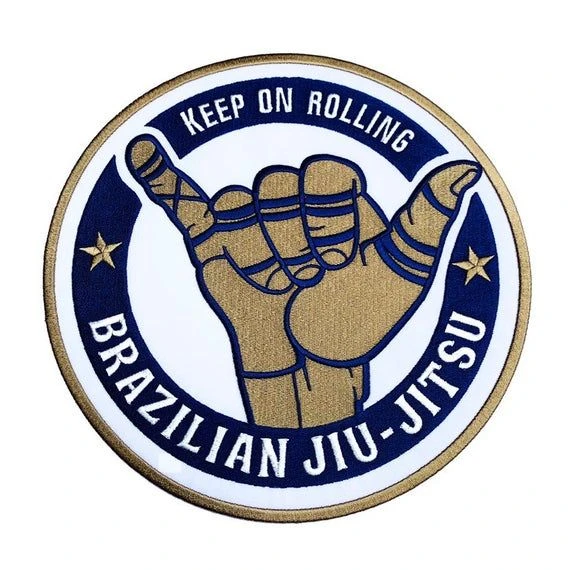
BJJ Patch Types: Which Material Should You Choose?
Not every patch style suits every use case. Some hold up better under grip fighting and repeated washing. Others are chosen purely for how they look. Here’s how the main options compare.
Embroidered Patches
Embroidered patches are the traditional choice for academy logos and belt rank symbols. Raised thread stitching gives them a textured, three-dimensional look that reads well from a distance — ideal for shoulder and back placements where visibility matters.
Pros:
- Highly durable through repeated washing and grip contact
- Textured, premium look that reads well at a distance
- Best choice for bold academy logos and rank symbols
Cons:
- Fine text or small logo details can lose clarity in dense stitching
- Slightly heavier than woven alternatives
Woven Patches
For logos with fine lines, small text, or gradient detail, woven patches are the better fit. Thinner thread produces a flatter, smoother finish than embroidery while still holding sharp detail — well suited to academy crests with intricate artwork or lettering.
Pros:
- Handles fine detail and small text that embroidery blurs
- Lighter and sits flush against gi fabric
- Cleaner look under competition lighting
Cons:
- Less textured, lower visual “pop” than embroidery
- Can fray at edges if not sewn securely
PVC Patches
PVC patches are molded from a rubber-like material that’s fully waterproof and fade-resistant. They’re less common on the gi itself but popular for no-gi rash guards, gym bags, and gear exposed to sweat outside a normal wash cycle.
Pros:
- Fully waterproof, won’t fade with heavy use
- Vibrant colors, ideal for rash guards and gear
- Zero fraying since there’s no thread
Cons:
- Too rigid for flexible movement zones on a gi
- Less traditional look than embroidered or woven
Chenille Patches
Chenille patches bring a soft, varsity-style texture that stands out on academy jackets, warmup gear, and team apparel worn off the mat.
Pros:
- Bold, retro varsity look for large team logos
- Great for hoodies, jackets, warmup gear
Cons:
- Too bulky for direct placement on a competition gi
- Not ideal for fine detail or small text
Leather Patches
Leather patches add a premium, understated look, most often used on gi bags, belts, or limited-edition apparel rather than the gi itself.
Pros:
- Premium, long-lasting appearance
- Holds up for years without wear
Cons:
- Limited color options compared to fabric patches
- Needs specialized stitching for secure attachment
Sublimated Patches
Sublimated (full-color printed) patches allow unlimited colors and photorealistic artwork without the thread limitations of embroidery — good for detailed mascots, gradients, or multicolor sponsor logos.
Pros:
- Unlimited colors, sharp photorealistic detail
- No thread limitations for complex artwork
Cons:
- Fades faster than embroidered patches with frequent washing
- Less durable under heavy grip fighting
Quick Comparison
| Patch Type | Best For | Durability | Detail Level |
| Embroidered | Shoulder/back logos, rank symbols | High | Bold designs only |
| Woven | Fine text, intricate crests | High | Excellent |
| PVC | Rash guards, bags, gear | Very high (waterproof) | Good |
| Chenille | Jackets, hoodies, warmups | Medium | Low (bold only) |
| Leather | Bags, belts, premium apparel | Very high | Low |
| Sublimated | Multicolor mascots, gradients | Medium | Excellent |
BJJ Gi Patch Placement: IBJJF Rules and Best Practices
Where to put patches on a BJJ gi isn’t just a stylistic choice. IBJJF-sanctioned events enforce specific placement rules, and getting this wrong can mean removing a patch at check-in or losing points before a match starts.
Shoulder Patch Placement
Shoulder placement is the most common spot for academy logos, sponsor patches, and team branding. IBJJF rules allow patches on both shoulders, making this the safest, most flexible placement for competitors who want visibility without compliance risk.
Chest Patch Placement
Chest patches typically carry the academy name or a rank symbol. IBJJF permits chest patches as long as they don’t interfere with the gi closure or lapel overlap — sizing and placement need to leave that area clear.
Back Patch Placement
A back patch is usually the largest patch on the gi and carries the heaviest visual weight — often a full academy logo or team name. IBJJF requires back patches to sit below the collar and above the beltline, so measure before ordering to avoid a patch that runs too long for that zone.
Lapel Patch Placement
Lapel placement is less common but adds a personalized touch, often used for name patches or small rank indicators. Lapel patches are typically allowed in competition but aren’t the preferred placement for most academies, since the lapel sees heavy grip contact during rolling.
Pants and Leg Patch Placement
Some practitioners add patches to the thigh or shin area of the gi pants — usually for funny BJJ patches or extra sponsor placement. IBJJF requires these patches to never interfere with movement, so thin, low-profile patches are the safer choice here.
| Placement | Best For | Compliance Note |
| Shoulders | Academy logos, sponsor patches | Allowed on both shoulders |
| Chest | Academy name, rank patches | Must clear the gi closure |
| Back | Large team logos | Below collar, above belt |
| Lapels | Name patches, small details | Allowed but less preferred |
| Pants/legs | Fun or funny designs, extra branding | Must not restrict movement |

BJJ Patch Etiquette: Dos and Don’ts
- Do confirm academy uniform policy before ordering — some gyms have rules beyond IBJJF requirements
- Do choose durable materials like embroidered or woven patches for any placement that sees regular grip contact
- Do make sure every patch is fully and securely attached before stepping on the mat — a half-attached patch is a snag risk during live rolling
- Don’t place patches anywhere they could catch a grip or interfere with a collar choke defense
- Don’t use offensive or disrespectful designs that could get a competitor removed from an event
- Do follow proper washing, drying, and maintenance techniques so patches last through years of training
How to Attach Custom BJJ Patches to a Gi
The application method affects both durability and how easily a patch can be swapped later. Three methods cover most BJJ use cases.
Sewing (Most Durable)
Sewing is the strongest, most permanent way to attach a patch, and the standard for anything that needs to survive years of training and washing.
- Position the patch and pin it in place
- Use a strong needle and thread that matches the patch color
- Stitch around the full perimeter, keeping the thread tight
- Reinforce the corners for extra hold
Best for: Shoulder, back, and chest patches meant to stay put permanently.
Iron-On (Fast and Simple)
Iron-on patches offer a quick alternative for competitors who want a patch applied in minutes.
- Set an iron to medium heat with no steam
- Position the patch on the gi
- Cover with a thin cloth and press for 30 to 60 seconds
- Let the patch cool fully before wearing or washing
Best for: Temporary or lower-contact placements. Not the most durable option for heavy training gis washed frequently.
Velcro (Removable and Versatile)
Velcro backing lets a competitor swap patches between competitions and regular training without resewing every time.
- Sew the Velcro strip onto the gi
- Attach the Velcro-backed patch
- Remove or switch patches as needed
Best for: Competitors who rotate sponsor patches or want different patches for training versus competition.
Removing and Replacing Gi Patches
Patches sometimes need to come off — an academy retiring an old logo, or a competitor updating a sponsor patch.
- Sewn patches: Use a seam ripper or small scissors to cut the stitches, then carefully pull out any loose thread
- Iron-on patches: A low-heat iron pass loosens the adhesive before peeling the patch away; use a fabric adhesive remover to clean up residue
- Velcro patches: Detach by hand — only the base strip itself needs unstitching if it has to come off too
Frequently Asked Questions
What is the best material for BJJ patches on a competition gi?
Embroidered patches are generally the best choice for competition gis because the raised stitching holds up to repeated grip fighting and machine washing without fraying or peeling. Woven patches are a strong second option when a design includes fine text or intricate detail that embroidery might blur. PVC and sublimated patches look sharp but are better suited to gear outside the gi itself, such as bags or rash guards.
Where can I place patches on a BJJ gi for IBJJF competition?
The IBJJF allows patches on both shoulders; on the chest as long as the patch doesn’t interfere with the gi closure; and on the back as long as the patch sits below the collar and above the belt line.
How long do BJJ patches last with regular training?
Embroidered and woven patches, when properly sewn onto a gi, typically last for years of regular training and washing without significant wear.
Can I order a single custom BJJ patch or does it require a minimum quantity?
Most patch types can be ordered as a single piece with no minimum quantity required, making custom BJJ patches accessible for an individual competitor who wants a personalized rank patch. Academies ordering for a full roster typically see lower per-patch pricing at higher quantities, since production costs drop as order size increases — but there’s no requirement to order in bulk to get a professional-quality patch.
Are funny BJJ patches allowed in competition?
Funny or novelty BJJ patches are generally allowed in training and casual wear, and on non-visible placements like pants or gear bags. For IBJJF competition, avoid offensive or disrespectful designs — officials can require removal before a match, so check tournament guidelines if a patch is anything other than a standard academy or sponsor logo.
Why Choose The American Patch for Custom BJJ Patches
The American Patch produces embroidered, woven, PVC, chenille, and leather patches built for the demands of BJJ gis and academy gear. Every order includes a free digital proof before production, so academies and competitors see the exact size, color, and backing before anything gets made.
There’s no minimum order requirement across most patch types — a single competitor ordering one rank patch gets the same quality and turnaround as an academy ordering a full team run. Bulk pricing is available for academies outfitting an entire roster, and every order is quality-checked by hand before it ships. Standard production runs seven to ten business days from proof approval, with rush options available for competitors working against a tournament deadline.
Contact us for a free quote and see your design before you commit to production.